
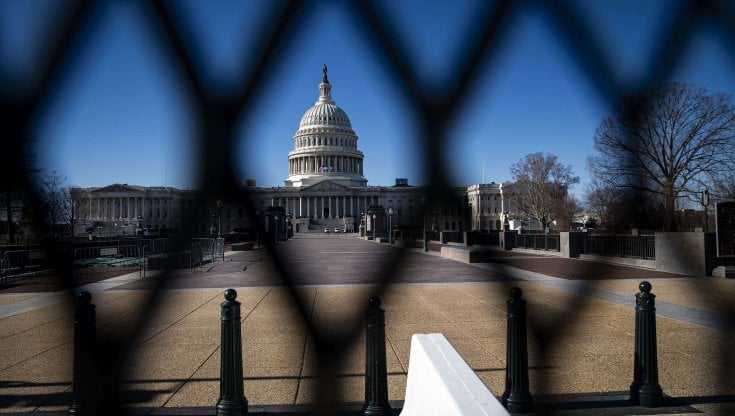
The populist uprising in Capitol Hill instigated by the current president and the simultaneous fierce criticism of Washington by autarchies are telling us that American democracy is under attack: object of a convergent aggression by its internal and external enemies, all of whom believe it is doomed to collapse. But this is the same fatal error of judgement committed by totalitarianism in the twentieth century.
The offensive against American democracy is described by what happened inside and outside the federal capital during the last five days. In Washington, President Donald Trump let hundreds of his extremist followers into the White House lawn, inciting them to "let their voice be heard" in Congress to prevent the ratification of Joe Biden's legitimate election and, soon after, they did so by violating the House and Senate and physically clashing with the police resulting in five deaths.
As soon as violent, populist and supremacist militant groups led the assault on the Capitol, Moscow and Beijing released a series of public statements pointing to the "failure of American values". For Konstantin Kosaciov, chairman of the Foreign Affairs Committee in the upper house of Russia' parliament: "America is limping on both feet, it no longer charts the course and has lost all right to set it", while Hua Chunying, spokesman for Beijing's Foreign Ministry, defines the agents at Capitol Hill "more brutal than in Hong Kong" where they hunt down students. Russia and China were joined by the Iranian President Hassan Rouhani, who spoke of the "weak foundations of Western democracy", and Diosdado Cabello, leader of the pro-Maduro Venezuelan socialists, who concluded that "the U.S.A is a disaster".
According to Yochai Benkler, a Harvard Law School professor who studies Russian disinformation campaigns on social networks in America, there is an obvious "element of convergence" between Trump's narrative and the Kremlin's. That is: "Throughout the election campaign, Trump has sown doubts about its legality" while the focus of the Russian cyber offensive is "to create a world where nothing is true and therefore anything is possible".
A newly released study by the Rand Corporation on Foreign interference in the 2020 Election provides a detailed map of Russian trolls and suggests that the key to understanding pro-Trump groups and QAnon sovereignists lies in the fact that "there is always someone or something that can make Trump win but at the last minute is prevented from going public". That is, the Russian 'malignant interference' documented by US authorities in the 2016 presidential campaign was present once more in 2020, but with such a high degree of sophistication as to find in Trump's narrative a tool for delegitimising the U.S. democratic system. Although it is impossible to say with complete certainty that Trump is complicit with the Russian cyber campaign, it is very difficult to deny the convergence of intentions in undermining from within the trust of citizens in representative democracy.
But this is precisely where American populists and foreign autocracies have been proved wrong by what happened in Washington. For four reasons. First of all, the attempt to block Biden's election failed within hours of the attack at the capitol with Vice President Mike Pence and House Speaker Nancy Pelosi presiding over a joint session of Congress, voting as scheduled according to the institutional agenda and showing a clear political cohesion against the insurgency, and against Trump, and respect for democratic rules.
Second, the top Republican leaders spoke with one voice: Senator Lindsey Graham defined the insurgents "terrorists and not patriots", and Liz Cheney, third-highest position in the House Republican Leadership, daughter of former President Dick and rising star in the party, said President Trump was "the cause of the assault on Capitol Hill". Mike Pence himself refused Trump's request to block Biden's election, and Secretary of State Mike Pompeo, along with Treasury chief Steven Mnuchin, expressed support for stripping the sitting president of his powers under the 25th Amendment.
Thirdly, the conversation between Nancy Pelosi, third ranking post in the U.S., and the Chairman of the Joint Chiefs of Staff, Mark Milley, on the necessity of preventing Trump from using nuclear weapons implies an active role for the armed forces in order to avoid new coups by Trump, who, it should be remembered, is closely watched by the presidential secret service.
Fourth, the fact that mainstream newspapers said Trump's statements are 'false' and some of the major digital networks suspended his accounts, underlines the role of the media in guaranteeing the protection of democratic values on the web.
In summary, the world leaders agreed, the top military brass closed ranks and the Fourth Estate acted on every platform to isolate Trump from his vociferous supporters. And, as a result, American democracy passed the most difficult and most unexpected test of resilience: a domestic insurgency led by her president.
This means not only that the populist insurgents failed to achieve their political goal in their assault to the Capitol, but also that the autocracies were once again too quick to declare victory. In so doing they show they don't understand that the strength of democracy - in America as elsewhere - lies in the consent of the people to the inalienable value of fundamental freedoms.
The enemies of democracy constantly make the mistake of underestimating the resilience of democracies when they attack them in the intent of tearing them down: Imperial Japan made the same mistake at Pearl Harbor, Nazi Germany during the Battle of Britain, Mao after the Korean War, the USSR after the fall of Saigon, and Al Qaeda by carrying out the 9/11 attack. Precisely when democracies appear at their weakest and most vulnerable, they are capable of expressing the most unexpected qualities, surprising their attackers.
The fact remains that Joe Biden faces an uphill battle: he has to reunite America despite the predictable effort Trumpists will make in tearing it apart and he has to strengthen ties with Western allies on the international chessboard where Moscow and Beijing are on the offensive. For a Cold War veteran like Biden, it means returning to the trenches of the global strategic challenge with a weaker, more uncertain, and more fractured network of alliances.
But his first moves look to the future: he asks his fellow citizens to 'wear masks' to defy populists denying the existence of the virus, and invites allied democracies to start working together immediately on recovery, climate and cybersecurity, as well as against pandemics, inequality and racism. It could be the genesis of a great pact against populism and autarky, capable of regenerating the community of democracies. In order to succeed Biden will need partners and allies who are equally determined and courageous, in Washington as well as abroad. That is why we too must repel the assault on American democracy.
Translated by Luis E. Moriones and Barbara Bacci
/https%3A//www.repstatic.it/content/nazionale/img/2026/09/09/180531597-f3b757bd-9599-46e0-8a90-cbc0be396a0c.jpg)
/https%3A//www.repstatic.it/content/nazionale/img/2026/09/22/205406740-5f885f6f-b3eb-4fa8-bbb3-d2887380dbc3.jpg)
/https%3A//www.repstatic.it/content/nazionale/img/2026/09/22/204521018-7cf8b5da-8921-4578-8cb1-be01777919ec.jpg)
/https%3A//www.repstatic.it/content/nazionale/img/2026/05/06/085359118-65bb303a-49b6-4557-813d-0d5ecbd7c055.jpg)
/https%3A//www.repstatic.it/content/nazionale/img/2025/10/27/094733208-f77a882a-ae3a-4020-9e66-4c8ec356c1c1.jpg)
/https%3A//www.repstatic.it/content/nazionale/img/2024/03/13/230413848-c81f7bda-0e7c-44ee-9133-9d6c0ecede85.jpg)