
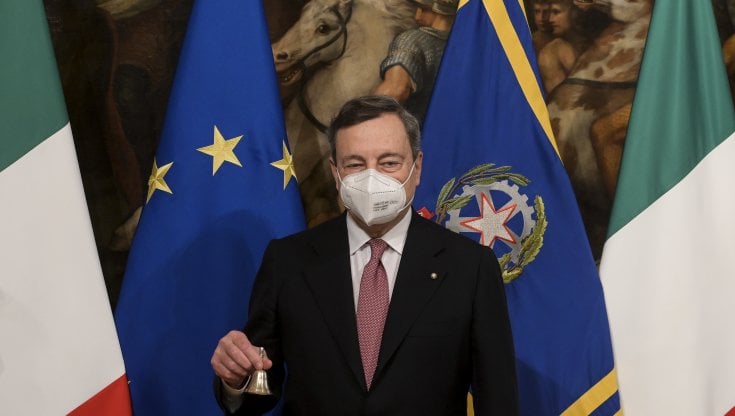
The coalition government headed by Mario Draghi has come into existence as a result of the agreement of the overwhelming majority of Italy's political parties at the request of Italy's president, Sergio Mattarella. Mattarella called on the nation's political forces to come together to rescue Italy from the grueling health and economic crises triggered by the Covid pandemic. The real question now is what direction to take in order to rebuild the country's manufacturing sector and steady its social fabric. This, the new Prime Minister declared, is the essence of his mission, in short, "to ensure Italy's safety."
Governo, il giuramento di Mario Draghi come presidente del Consiglio
The answer that Italy receives from the OECD - the Organization for Economic Cooperation and Development, an association of the most industrialized nations - and from the European Union is unequivocal: what is needed is a "green" recovery, in order to ensure that overlapping measures to protect the planet's climate and stimulate economic development successfully engender, on the one hand, strong popular solidarity, and on the other, prosperity.
At least 30 OECD nations - out of a total of 37 - have already incorporated measures in support of "transition toward greener economies" into their recovery programs, with a focus on four major types of interventions: tax measures to encourage green transportation, research into clean energy and the circular economy; support for families and companies that choose to install green infrastructure; financing to create jobs in green sectors; as well as protection of biodiversity and, in more general terms, of nature. Situations range widely: they run from countries that are modifying motorized vehicle parking facilities to make room for bike lanes, public transportation, and pedestrian infrastructure to other nations that have opted, instead, to provide incentives for clean technologies in sectors such as aviation and the auto industry.
This is an overall strategic direction that aligns with the European Union's "Next Generation EU" plan - the 750 billion euro Recovery Plan approved last May - because it is based on the "European Green Deal," which requires the 27 member nations to undertake concrete action in every sector of the economy: ranging from the reduction of harmful emissions by the development of renewable energy projects to investment in green technologies, and from new public and private eco-compatible transportation systems to the construction of buildings that would support the circular economy, all the way out to the requirement of international partners determined to improve standards of environmental respect. If we sum up the input from OECD and the EU, we come face to face with a vast range of options we can draw upon to align the specific demands of our national development with the interests of climate protection. It is up to each country to choose its own path along this shared path for industrial democracies.
Last July, for instance, South Korea committed to a detailed five-year plan worth roughly an estimated 61 billion dollars in the belief that it can create 659,000 jobs, increasing the production of renewable energy from 12.7 GW to 42.7 GW, expanding the national fleet of hydrogen-powered vehicles and modernizing schools and public buildings with a view to reducing harmful emissions to zero and transforming urban areas into "green smart cities," meaning cities where high technology and environmental protection can improve their inhabitants' quality of life. If we add to this array of developments the fact that one of the first decisions made by the new American president Joe Biden and his vice president Kamala Harris was the creation of a White House task force of experts in order to "create jobs and cut harmful emissions," then it's reasonably straightforward to come to the conclusion that reconstruction in the aftermath of the pandemic is taking on the characteristics of a redefinition of the Western economic system, with focus on the importance of protecting the middle class from two converging threats to our collective security: job losses and climate change.
This is the territory upon which the three great overarching socioeconomic phenomena that have marked the beginning of the twenty-first century now converge: technological innovation and its effects on the job markets, respect for the importance of the climate as an increasingly widely shared value, and the battle against the inequality caused by the wounds inflicted by globalization. When the American Secretary of State Antony Blinken states that Western democracies are all now being confronted by the same type of "domestic challenges," he is identifying the reasons that are encouraging the OECD and the EU to proceed in the same direction: pandemic, labor, climate, and inequality are all different aspects of the need to redefine a socioeconomic model capable of ensuring protection and prosperity to their own citizens. And in order to succeed in that, we need new indicators of prosperity, new policies of intervention, and new forms of work, namely an updated model of the concept of economic justice.
To the government of Mario Draghi, this is tantamount to being able to plan the country's reconstruction in a European and Western context, capable of bringing about a multiplication of resources and opportunities. In part because Italy, which is taking its turn chairing the G20, may play a leadership role on the global stage, in view of the UN climate summit Glasgow this fall. The objective will be not only to reconcile Brussels' and Washington's recipes for a "green recovery," but also to persuade the other G20 partners, who are continuing to invest in fossil fuels - starting with China and India - of the importance of a green future.
(Translated by Antony Shugaar)
/https%3A//www.repstatic.it/content/nazionale/img/2026/06/25/235925253-5fec8ed8-c2a0-47dd-9ff5-8e0d137a76c7.jpg)
/https%3A//www.repstatic.it/content/nazionale/img/2026/06/25/235644610-eeb58a91-519e-4677-be77-a98bde256f59.jpg)
/https%3A//www.repstatic.it/content/nazionale/img/2026/06/15/215432083-e4a9c58a-7246-4846-9625-afa5dc39a96f.jpg)
/https%3A//www.repstatic.it/content/nazionale/img/2026/05/06/085359118-65bb303a-49b6-4557-813d-0d5ecbd7c055.jpg)
/https%3A//www.repstatic.it/content/nazionale/img/2025/10/27/094733208-f77a882a-ae3a-4020-9e66-4c8ec356c1c1.jpg)
/https%3A//www.repstatic.it/content/nazionale/img/2024/03/13/230413848-c81f7bda-0e7c-44ee-9133-9d6c0ecede85.jpg)