
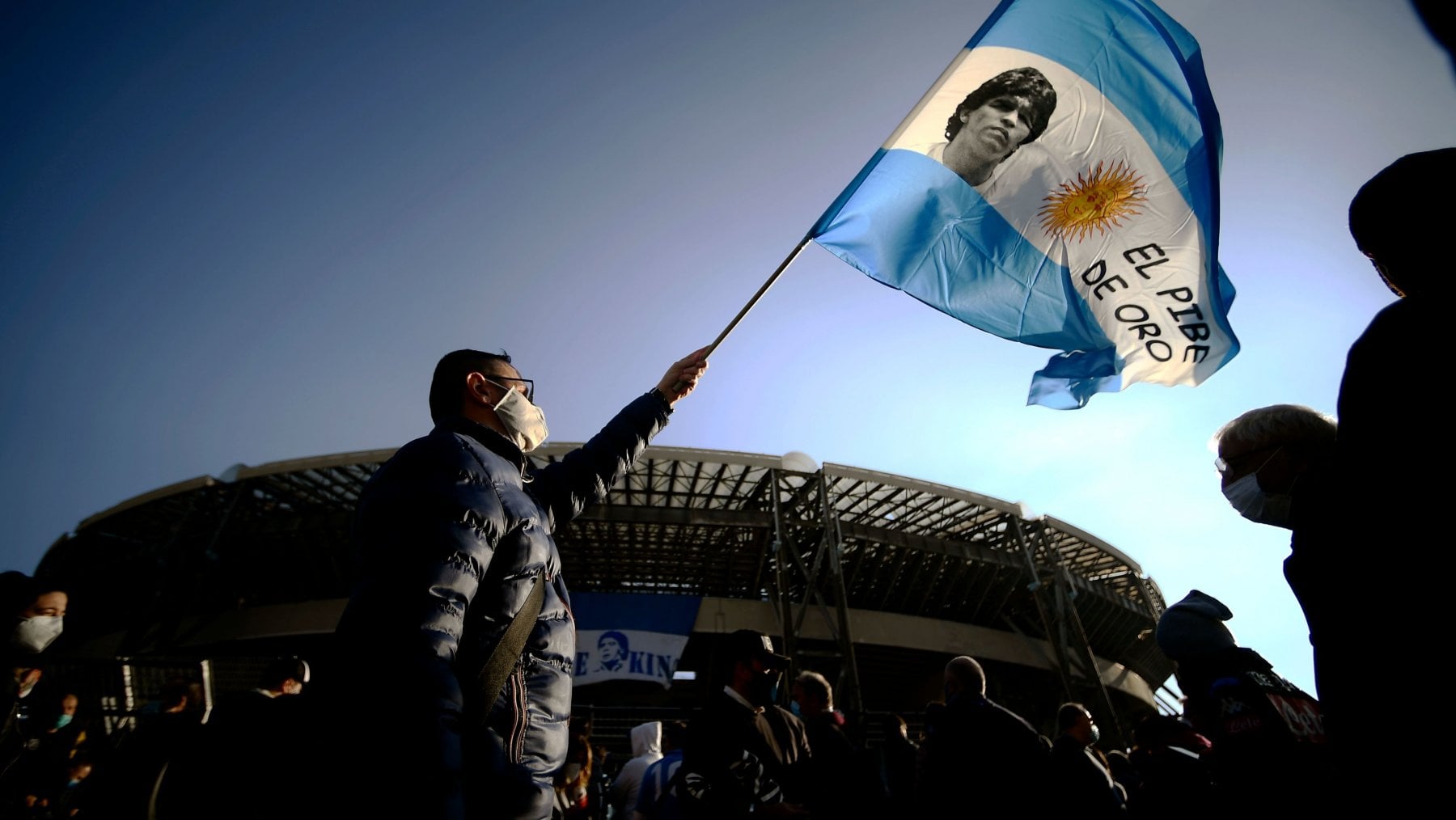
All I know is what I remember. And I remember that it was a season never to be repeated, a moment when lightheartedness aligned perfectly with freedom. It was true for the youth of my generation, as it was for all the rest. It was true for Maradona. He was lighthearted, and so he was free. As were we. All of us – kids, teenagers, adults young and old – discovered a new and unexpected childhood, at least on Sundays.
My father, disappointed and bitter ever since they’d fired Coach Vinicio, his idol, had never set foot inside San Paolo Stadium again. He finally went back, years later, to see Maradona’s first match. I went with him. It was pouring. The ball, soaking wet and as heavy as a coffee table, drops out of the clouds. Maradona glues the ball to his foot as if it were routine. The opposing team doesn’t move, they all stand there staring. Better to learn than to fight. They’ve grasped in an instant the lesson from Amiel that everyone else always forgets: “Any direct resistance results in disaster.” With the same carefree ease, Maradona makes an impossible pass. None of his teammates move, because at the time, no soccer player believes such a thing is even possible. The genius is on his own, as always. My father was irritated. “They don’t understand him,” he said, and that was it, he never set foot inside the stadium again.
That was how it all started, and it would almost always be that way. We didn’t understand him. Because he came from some other place. Either too far away, or too close.
After that, Sundays meant meeting on the corner at 1:00 in the afternoon with a serious, staid engineer by the name of Giampaolo Galluzzi. An impeccable professional on weekdays. On Sundays, an uncontrollable madman. Six of us would squeeze into his Fiat 850, which always seemed to me the most beautiful car in the world with its strange, fan-shaped odometer and colored blinkers, like little television sets. Once we got to Fuorigrotta, we’d pick up Giampaolo Galluzzi’s grandfather’s lover. She had to come to the stadium with us. She brought good luck. Galluzzi would hand her two bags of salt, which - as soon as the teams took the field - she would fling at the crowd. Salt in their hair, down their shirts, people would grumble and insult us. Galluzzi, risking a lynching, would shout mercilessly: “There, you jinxes!” And he really believed it as, like one possessed, he hurled handfuls of coarse salt at them, practically giving himself a heart attack. We would laugh and hide, terrified of the brawl we brushed up against every Sunday. This is what is called lightheartedness, or – if you prefer – happiness. Naples in the 1980s. Moved, I watch it all again, grainy now from the wear of the VHS, the pyrotechnic ruckus of joy of those years. We really were like that – laidback, free and easy, immersed in an ecstatic suspension, naïve, clinging to our Piaggio motor scooter seats, with or without a shift. Loud, souped-up Vespas. Some – only the important deadbeats – even drove a Caballero, an orgy of noise. Smog everywhere. Thefts, screams, brawls, cheap vacations. Scenes vulgar and sublime. Injustices right around the corner, reckless, and always unpunished. And yet it was impossible not to seep yourself in this life. And to feel unique.
Let’s face it, people from Naples have always considered themselves to be unique. Special. Snobs or working class, clever or clumsy, industrious or indolent, but always with an ironclad, extravagant awareness of being a world apart.
People in Naples say it all the time: “We Neapolitans...” The rest of the sentence invariably implies the same idea: the rest of you, you’re not from Naples, so you’re merely ordinary people, dull, predictable, honest, conventional. For years, this alleged awareness lacked an adequate sounding board, and so never made it further north than the Caserta tollbooth. It became an arid ostentation, like one of those things insane people in an asylum say: “I am Napoleon.” But when Maradona arrived, we found our sounding board. With every step, with every tug of some fanatical kid, stunned and confused, on the street or the soccer field, it was as if he were telling us, with his shy, ancient smile: “I’ll let the whole world know that you Neapolitans are unique, special, beautiful. You are all Napoleon.” And we believed it, we still believe it. Maybe that’s why we loved him so much. He let us out of the asylum. And he made us into something phantasmagoric and plausible all at once. Or maybe he merely deluded us. But it doesn’t matter. It’s a useless, idle distinction that moralists, sick with realism, can’t begin to understand, not even with their goodwill and their Masters degrees from prestigious universities. Because Maradona instilled in us a complex, inhuman, elusive art: the ethereal, explosive, inalienable wisdom of play. By explaining to us, right from the start, that art, life, and illusion are one and the same thing. And that flaws and fragility, swiftness of mind and of muscle, ignorance and intelligence, are all part of the same, marvelous, priceless, and immensely pardonable muddle called the human adventure. Maradona, like all highly gifted talents, was shameless, fragile and touching. We all wanted to embrace him, and he carried the terrible, insatiable weight of all our arms around him. Another form of solitude. Another form of suffering, to be weighed down by a troubled love that, in a flash, turned into idolatry.
Things went the way they did, but with his sad smile, Maradona freed us – us Neapolitans – from our straightjackets and made us lighthearted, at least for a while. He touched the ball with nonchalance, indulgence, and elegance, and he gave us, in the eyes of the universe and eternity, that same illusion of ease. That most powerful synonym for freedom. Maradona was us because we had always been like him – except that the others, those in the world’s infinite, industrious, hard-working, efficient north, didn’t know it. Now, thanks to Maradona, they had to. They couldn’t avoid noticing a sinister, disturbing novelty: in Naples, we were happy. Because a brilliant, weak, human being – all too human – gracefully told us every week what we already knew, but, before him, were not able to see: the effusive energy of spectacle, the grace of dancing with the ball, the heroism of falling in the mud, the temptation of arrogance, the liberation from victimhood, the possibility of winning – not to be able to say we were first, but to have a legitimate reason to rejoice, without feeling guilty, for as long as we wanted, authorized to let down our guard and lounge on the shore, as in some long summer vacation with no return ticket, justified, even, to dabble in rhetoric, making us feel like a people. United. High and low. Rich and poor. The afflicted and the easygoing. Art allows for no distinction among its admirers. We were all equal. We were all Napoleon. Small and unpredictable, like the emperor Maradona, free and irresponsible, lighthearted and smiling.
I know what the objection is: you were happy because you were young. No, that’s not the way it was. We were all fully kids then, because there was another kid in our midst whose name was Maradona.
Now, our youth, which vanished long ago, has been ratified, made official, by his death. Broken by his struggle to live. But it doesn’t matter. Because we will always be moved by his big, shy smile, which now will never leave us.
Translated from the Italian by Virginia Jewiss
My father, disappointed and bitter ever since they’d fired Coach Vinicio, his idol, had never set foot inside San Paolo Stadium again. He finally went back, years later, to see Maradona’s first match. I went with him. It was pouring. The ball, soaking wet and as heavy as a coffee table, drops out of the clouds. Maradona glues the ball to his foot as if it were routine. The opposing team doesn’t move, they all stand there staring. Better to learn than to fight. They’ve grasped in an instant the lesson from Amiel that everyone else always forgets: “Any direct resistance results in disaster.” With the same carefree ease, Maradona makes an impossible pass. None of his teammates move, because at the time, no soccer player believes such a thing is even possible. The genius is on his own, as always. My father was irritated. “They don’t understand him,” he said, and that was it, he never set foot inside the stadium again.
That was how it all started, and it would almost always be that way. We didn’t understand him. Because he came from some other place. Either too far away, or too close.
After that, Sundays meant meeting on the corner at 1:00 in the afternoon with a serious, staid engineer by the name of Giampaolo Galluzzi. An impeccable professional on weekdays. On Sundays, an uncontrollable madman. Six of us would squeeze into his Fiat 850, which always seemed to me the most beautiful car in the world with its strange, fan-shaped odometer and colored blinkers, like little television sets. Once we got to Fuorigrotta, we’d pick up Giampaolo Galluzzi’s grandfather’s lover. She had to come to the stadium with us. She brought good luck. Galluzzi would hand her two bags of salt, which - as soon as the teams took the field - she would fling at the crowd. Salt in their hair, down their shirts, people would grumble and insult us. Galluzzi, risking a lynching, would shout mercilessly: “There, you jinxes!” And he really believed it as, like one possessed, he hurled handfuls of coarse salt at them, practically giving himself a heart attack. We would laugh and hide, terrified of the brawl we brushed up against every Sunday. This is what is called lightheartedness, or – if you prefer – happiness. Naples in the 1980s. Moved, I watch it all again, grainy now from the wear of the VHS, the pyrotechnic ruckus of joy of those years. We really were like that – laidback, free and easy, immersed in an ecstatic suspension, naïve, clinging to our Piaggio motor scooter seats, with or without a shift. Loud, souped-up Vespas. Some – only the important deadbeats – even drove a Caballero, an orgy of noise. Smog everywhere. Thefts, screams, brawls, cheap vacations. Scenes vulgar and sublime. Injustices right around the corner, reckless, and always unpunished. And yet it was impossible not to seep yourself in this life. And to feel unique.
Let’s face it, people from Naples have always considered themselves to be unique. Special. Snobs or working class, clever or clumsy, industrious or indolent, but always with an ironclad, extravagant awareness of being a world apart.
People in Naples say it all the time: “We Neapolitans...” The rest of the sentence invariably implies the same idea: the rest of you, you’re not from Naples, so you’re merely ordinary people, dull, predictable, honest, conventional. For years, this alleged awareness lacked an adequate sounding board, and so never made it further north than the Caserta tollbooth. It became an arid ostentation, like one of those things insane people in an asylum say: “I am Napoleon.” But when Maradona arrived, we found our sounding board. With every step, with every tug of some fanatical kid, stunned and confused, on the street or the soccer field, it was as if he were telling us, with his shy, ancient smile: “I’ll let the whole world know that you Neapolitans are unique, special, beautiful. You are all Napoleon.” And we believed it, we still believe it. Maybe that’s why we loved him so much. He let us out of the asylum. And he made us into something phantasmagoric and plausible all at once. Or maybe he merely deluded us. But it doesn’t matter. It’s a useless, idle distinction that moralists, sick with realism, can’t begin to understand, not even with their goodwill and their Masters degrees from prestigious universities. Because Maradona instilled in us a complex, inhuman, elusive art: the ethereal, explosive, inalienable wisdom of play. By explaining to us, right from the start, that art, life, and illusion are one and the same thing. And that flaws and fragility, swiftness of mind and of muscle, ignorance and intelligence, are all part of the same, marvelous, priceless, and immensely pardonable muddle called the human adventure. Maradona, like all highly gifted talents, was shameless, fragile and touching. We all wanted to embrace him, and he carried the terrible, insatiable weight of all our arms around him. Another form of solitude. Another form of suffering, to be weighed down by a troubled love that, in a flash, turned into idolatry.
Things went the way they did, but with his sad smile, Maradona freed us – us Neapolitans – from our straightjackets and made us lighthearted, at least for a while. He touched the ball with nonchalance, indulgence, and elegance, and he gave us, in the eyes of the universe and eternity, that same illusion of ease. That most powerful synonym for freedom. Maradona was us because we had always been like him – except that the others, those in the world’s infinite, industrious, hard-working, efficient north, didn’t know it. Now, thanks to Maradona, they had to. They couldn’t avoid noticing a sinister, disturbing novelty: in Naples, we were happy. Because a brilliant, weak, human being – all too human – gracefully told us every week what we already knew, but, before him, were not able to see: the effusive energy of spectacle, the grace of dancing with the ball, the heroism of falling in the mud, the temptation of arrogance, the liberation from victimhood, the possibility of winning – not to be able to say we were first, but to have a legitimate reason to rejoice, without feeling guilty, for as long as we wanted, authorized to let down our guard and lounge on the shore, as in some long summer vacation with no return ticket, justified, even, to dabble in rhetoric, making us feel like a people. United. High and low. Rich and poor. The afflicted and the easygoing. Art allows for no distinction among its admirers. We were all equal. We were all Napoleon. Small and unpredictable, like the emperor Maradona, free and irresponsible, lighthearted and smiling.
I know what the objection is: you were happy because you were young. No, that’s not the way it was. We were all fully kids then, because there was another kid in our midst whose name was Maradona.
Now, our youth, which vanished long ago, has been ratified, made official, by his death. Broken by his struggle to live. But it doesn’t matter. Because we will always be moved by his big, shy smile, which now will never leave us.
Translated from the Italian by Virginia Jewiss


/https%3A//www.repstatic.it/content/nazionale/img/2026/09/27/144432385-25ef9433-c507-41be-af9d-7c2734f26807.jpg)
/https%3A//www.repstatic.it/content/nazionale/img/2026/09/26/214213945-fff79bbd-60ce-414d-9bd1-8565b5a8a6ba.jpg)
/https%3A//www.repstatic.it/content/nazionale/img/2026/09/24/174319734-0e414c72-601f-4e3a-baa6-2d225fa6a9cf.jpg)
/https%3A//www.repstatic.it/content/nazionale/img/2026/05/06/085359118-65bb303a-49b6-4557-813d-0d5ecbd7c055.jpg)
/https%3A//www.repstatic.it/content/nazionale/img/2025/10/27/094733208-f77a882a-ae3a-4020-9e66-4c8ec356c1c1.jpg)
/https%3A//www.repstatic.it/content/nazionale/img/2024/03/13/230413848-c81f7bda-0e7c-44ee-9133-9d6c0ecede85.jpg)

