303 days after the 7 October attack, the ongoing conflict in the Middle East has clearly taken on the characteristics of a war between Iran and Israel, the first to be fought head-on since the Khomeinist revolution prevailed in Tehran in 1979 with the strategic objective of destroying the Jewish state. And it is a conflict that shows some similar - but also some very different - elements to the first Arab-Israeli war of 1948.
The most obvious overlap between 1948 and today is the target of those attacking Israel. Back then, it was six Arab states (Egypt, Syria, Jordan, Lebanon, Iraq and Saudi Arabia) that set out to destroy the Jewish state, which was created on the basis of Resolution 181 passed on 29 November 1947 by the UN Security Council, by killing or throwing all its inhabitants into the sea. Today, there are five pro-Iranian militias - Hamas, Hezbollah, Islamic Jihad, Houthi and Kataib Hezbollah - attacking from Lebanon, Syria, Gaza, the West Bank, Yemen and Iraq, with the direct participation of Iran - with the missile attack on the night of 13 April - again with the declared aim of wiping Israel off the map. Also in 1948, the conflict was long - 18 months - had several different tactical phases, affected every corner of Israel and saw the Arab-Palestinian civilian population suffer heavy consequences - in terms of casualties, refugees and destruction - due to the fierce fighting between adversaries. But above all, then as now, the order of the Middle East was at stake: in 1948 the Sunni Arab states wanted to impose their nationalism, today Shia Iran pursues hegemony from Hormuz to Suez.
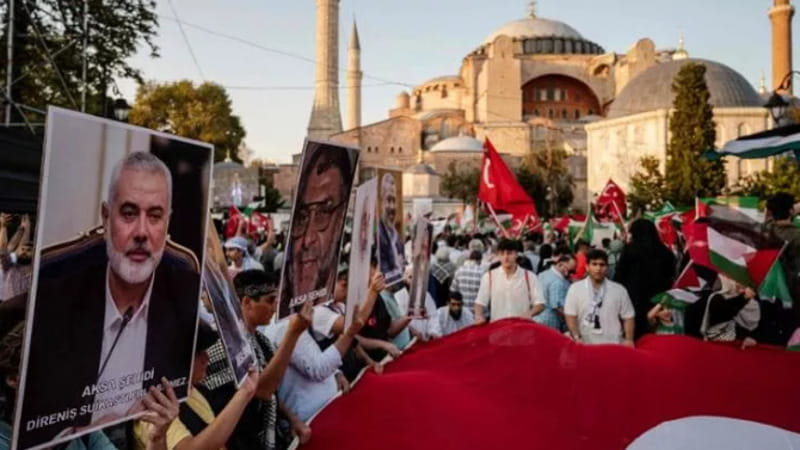
It is this framework that allows us to understand what is ripening in these hours on the battlefield that stretches from the Israeli beaches to the Strait of Bab el-Mandeb to the mountains of Iran. If Hamas's pogrom against Israel on 7 October opened the conflict, the cross-attacks between Israel and pro-Iranian militias that have followed since then have turned it into a regional war, and the 13 April rain of Iranian missiles and drones on the Jewish state marked Iran's direct entry into the field. But it is what happened in the last two weeks that triggered the turning point: the Houthis breached Tel Aviv's defences with a kamikaze drone and Israel in response destroyed the Yemeni port of Hodeidah 2000 km away; Hezbollah killed 12 Druze children with a missile on the Israeli Golan and Israel responded by eliminating Hezbollah's number 2 in Beirut a few hours before killing Hamas's political leader Ismail Haniyeh in Tehran. On both fronts, therefore, the ability to strike the enemy on its own ground has been demonstrated, causing significant damage not only from a military point of view but on the ground of prestige, which in the Middle East is what counts most because it coincides with force projection.
Hence the likely scenario we now face of an acceleration and extension of the direct confrontation between Iran and Israel. With Supreme Leader Ali Khamenei ordering to "strike back at the Zionist enemy" and Prime Minister Benjamin Netanyahu preparing his citizens "for difficult days" by letting them know that this time - unlike in response to the April attack - "Israel will respond".But precisely because we are on the verge of open war between Tehran and Jerusalem, both with weapons so powerful and sophisticated that they can cause devastating damage, the differences with what happened in 1948 can be counted.
The most obvious is the existence of a buffer of states between the contenders that has an interest of its own. These are the Sunni countries of the Middle East that are at peace with Israel (Egypt, Jordan, the United Arab Emirates, Bahrain and Sudan) or are engaged in negotiating it (Saudi Arabia, Oman). And since the aftermath of 7 October, although everyone has harshly criticized Israel for the heavy Palestinian death toll from the military operations in Gaza, no one has gone so far as to break off diplomatic relations or renounce negotiations: for the simple reason that they fear more than anything else the hegemony of the Shiites in Tehran, with whom they have a religious dispute that dates back to Muhammad's succession. This means that between Israel and Sunni countries there is an unspoken convergence to contain Iran. With one conspicuous exception: Recep Tayyip Erdogan's Turkey, also Sunni but not Arab, which aims to become the regional leader by wresting from Iran the leadership of the camp hostile to Israel and rallying all fundamentalist groups, to the point of attempting with the trusted Khaled Meshal to take over the political leadership of Hamas.
But that is not all, because there is another difference from 1948. At that time, the great powers chose a very timid attitude: the USSR supported Israel without saying too much, and Great Britain did the same with the Arab countries, while the United States, although on the side of the Jewish State, remained at a distance. Instead, the great powers are today as present as they are visible on the ground: the US deploys military ships and planes in quantity, and coordinates from the Central Command in Tampa the inter-Allied air defence that protects Israel, while Russia is the major supplier of advanced weapons to Iran, with which it carries out periodic military maneuvers, sometimes also associating the forces of China.This means that if the first Iran-Israel war enters its most dramatic phase, triggering effects that are difficult to predict, it will be the choices of the Sunni countries and the great powers that will make the difference. This confirms that the clash over the existence of Israel and the balance of power in Middle East is part of the global security challenge. For European countries, which support the "Two Peoples and Two States" formula for coexistence between Israel and the Palestinians, the choice is between the commitment to strengthen the "Abraham Accords", based on peace agreements, and acquiescence before Tehran's hegemonic design.