On Oct. 7 a year ago, Hamas' pogrom against Israeli villages in the Negev
not only triggered the war that runs through the Middle East but also
produced the most violent and extensive campaign of anti-Jewish hatred
that Diaspora communities have endured since the end of World War II.
Understanding why what happened is crucial to enable democracies-where
the majority of Jews live-to defend themselves against a form of
intolerance that assaults the cardinal principles of the Rule of Law.
The campaign of anti-Jewish hatred begins in the days immediately following
Oct. 7, 2023 when, in the face of Hamas violence, two phenomena occur:
pictures with photos of Israelis hostages are ripped in the streets,
from New York to Paris; the pogrom is legitimized by an offensive on
social media describing it as an "act of resistance against the
occupation" by pointing to villages that have been within Israel's
borders since its birth in 1948 as "occupied lands." Lack of pity for
the victims and delegitimization of Israel's existence are the initial
building blocks of a disinformation campaign to support Hamas'
fundamental intent: the Jewish state must disappear and all Jews must be
eliminated.
It is the overlap between anti-Zionism and anti-Semitism that dates back
to when, a few days after the start of the 1967 war, a Soviet diplomat
at the UN announced the reversal of Moscow's Middle East policy by
equating Zionism with "colonialism" and "racism" in order to push Arab
countries to side with the Kremlin in the Cold War. From then on,
anti-Zionism entered the Soviet propaganda narrative in the West,
penetrated pro-Urss political forces and spread to more nations, with an
intensity that followed the course of conflicts in the Middle East:
after the Yom Kippur War, the UN General Assembly in 1975, led by the
pro-Russian majority, calls Zionism "racism"; with the 1982 war in
Lebanon, the writings equipping Stars of David and hooked crosses also
reach Italian cities, and a two-year-old boy, Stefano Taché, is killed
in the Arab-Palestinian attack on the Synagogue in Rome; with the Cold
War over, with the second Intifada of 2000-2005, when Hamas was
detonating suicide bombers on buses, street demonstrations sweep across
Europe triggering violence that in 2006 led to the kidnapping and
killing of 24-year-old French Jew, Ilan Halimi.
Such precedents testify that hatred against Israel leads to attacks on
Diaspora Jews, but it is only after Oct. 7 that this phenomenon takes on
unprecedented dimensions: from the United States to Germany, from
Britain to Italy to Australia, every democracy registers dizzying surges
of intolerance and attacks of all kinds-even physical ones-on Jewish
individuals and property. In some cases, these are individuals and
groups wanting to show solidarity with the high number of Palestinian
civilian victims of Israel's military intervention in Gaza, singling out
Prime Minister Benjamin Netanyahu as the one responsible for the war,
but the battle cry "Palestine will be Free from the River to the Sea"
confuses criticism of the Jerusalem government with Hamas' campaign to
wipe Israel off the map. There is an important part of Israeli society
that, every Saturday night, takes to the streets against Netanyahu
demanding his resignation, but the pro-Hamas' cry "Let's free all
occupied Palestine" means denying even the existence of those who oppose
the government led by the Likud leader. That is why, whatever political
criticism of a government of Israel may be, it should never lead to
denying the state's right to exist.
It is when this difference disappears that the wave of hatred we are
witnessing is generated, where the hunt for the "Zionist" becomes an
anti-Jewish act: Jewish students on many American campuses insulted as
such, public events in Manhattan in support of the Hamas pogrom, a
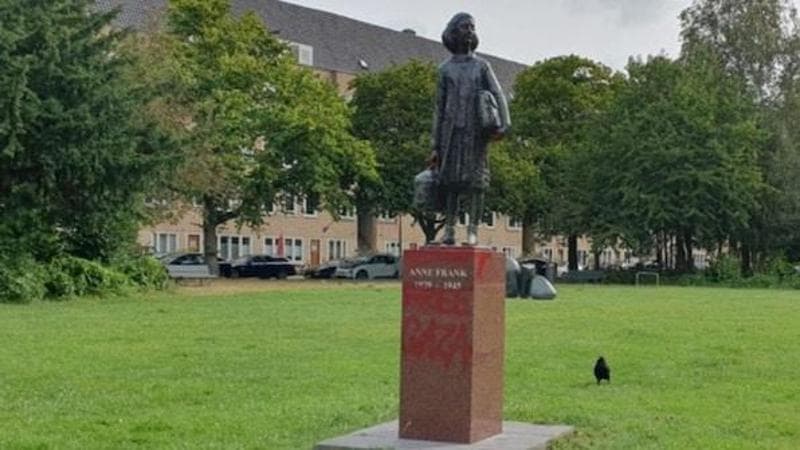
statue of Anne Frank in Holland daubed with the words "Free Gaza," the
cry "out Jews from the borders" shouted on the streets of Milan, and a
multitude of synagogues attacked on multiple Continents, up to the one
in Rouen set on fire. Those who attack Jews accuse them of being
"Zionists" just as a far-left group did in the week before Oct. 9,
1982-the day of the attack on the major synagogue in Rome-when it posted
on the gates of a minor synagogue, also in the capital, a white banner
with the red inscription "We will burn the Zionist hideouts." As French
philosopher Bernard-Henri Lévy observes, "the indiscriminate hatred of
Israel present in the democratic societies of our day is reminiscent of
what the French had for the Jewish captain Alfred Dreyfus," who was
wrongly convicted in 1894 for pro-German espionage before being
rehabilitated.
It is this wave of intolerance that has turned the lives of millions of
Diaspora Jews upside down in the past 12 months, raising questions of
security, personal and collective, that no one after 1945 had asked.
This explains why the Holocaust survivors' pain in witnessing the
reawakening of the worst ghosts of the past, when hating Jews was
legitimate. The words, simple and courageous, spoken on several
occasions by Liliana Segre, Sami Modiano and Edith Bruck are there to
testify to the reopened wound. To which the intolerant reacted with
horrendous insults, even to the point of calling Segre a "Zionist
agent."
All this also wounds our republican democracy, which, however, has
important antidotes in its DNA. It was Jan. 27, 2016, when the President
of the Republic, Sergio Mattarella, chose Memorial Day to affirm that
"anti-Semitism sometimes screens forms of anti-Zionism." Just as it was
his predecessor Giorgio Napolitano, on January 25, 2007, who said, "No
to anti-Semitism even when it disguises itself as anti-Zionism because
this means denial of the inspirational source of the Jewish state." For
about twenty years, the major political forces in Parliament, both
majority and opposition, have shown that they share this thought of the
last two presidents. But today the most extreme voices, on the left as
well as on the right, too often suffer the allure of a generalized form
of intolerance against Israel that attacks Jews but actually threatens
every Italian and European citizen. Because when the rights of a
minority are attacked it is the freedom of all that suffers.