
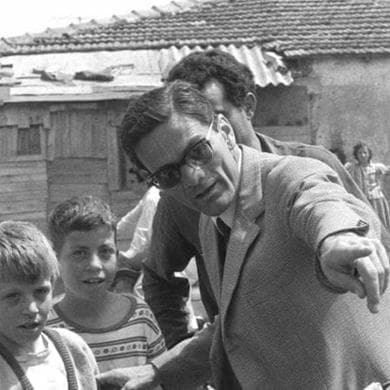
Soon the years of his presence will equal those of his absence. He was 53 when he was murdered. Fifty-one today in a country that has not slipped into its beautiful sea, has not liberated the world, but remains suspended like a tiny spider on a thread of saliva, caught between the insubstantiality and the impossibility of calling itself an orphan of a father who was never a father. Indeed, forever a son. The news is that there is a new inquiry into the murder of Pasolini, who was brutally killed at the Ostia Idroscalo. There is a long, despairing list of investigations into the case: opened, closed, rejected or shelved. The last one, seemingly the final nail in the coffin, was in 2015. Now there is some hope: a previously unheard witness, never before interviewed, ready to speak. At last. Let us hope, then. And let us hope that someone will also take the trouble to read Walter Siti, who has studied every comma of PPP’s work, to the point of feeling sick, to the point of saying ‘enough is enough’ – decipher Pasolini for yourselves, try being heretics enough to lose your lives for it. Feel the pain of the pirates in the storm. Read Siti. Listen to Ascanio Celestini, who has woven the memory of the 20th century into a museum dedicated to him: a poem written at the age of seven, the cemetery at Casarsa, a faux-leather bag that goes ‘boom’ in a bank in Milan in 1969, memories of that modest flat in Ponte Mammolo, Via Giovanni Tagliere 3, the Aniene, the little train, a circus, an elephant, a biscuit. Ascanio, who breaks the spider’s threads but weaves together coincidences; for — look — coincidences are important for understanding; they are the corners of the spider’s web. Pier Paolo Pasolini’s date of birth: 1922, year 1 of the Fascist era and the March on Rome, right up to that very night, the night between 1 and 2 November 1975. Five years earlier, in 1970, the failed coup by Junio Valerio Borghese. In the same year, 1975, the Circeo massacre carried out by three ‘good lads’ who never faced justice. And then that night, that very night. Let us hope. Let us hope the sticky tapestry crumbles to dust and that the truth is finally transformed into justice.
INSTEAD CONCITA
Pasolini and the canvas of the spider
di CONCITA DE GREGORIO
Translated with AI
|
This article was translated from the Italian original using AI, without editorial review.
For feedback, please contact translation@repubblica.it
For feedback, please contact translation@repubblica.it
From a new
witness
hope
of the truth