
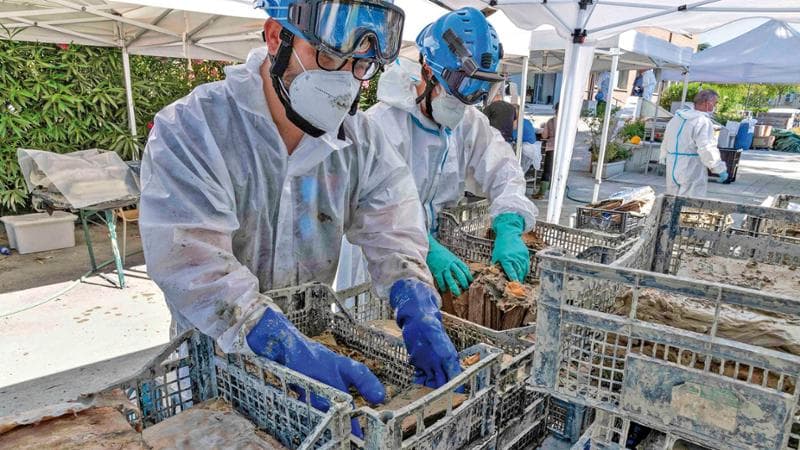
ROME – Rome is a city of house moves. Every day, specialist removal companies empty homes destined to be renovated and turned into tourist accommodation. Furniture and household belongings end up, at best, in vans bound for the dump. But personal libraries are often simply dumped in the street, beside the rubbish bins. Almost as though no one wants to take that final step: throwing books away with the rubbish.
A lingering sense of shame still prevents us from doing so. Perhaps the phylogenetic memory of our species tells even non-readers — the majority of the population — that these objects, books, were once something important, almost sacred to human beings, even before the invention of printing and paper.
Memory restored
The image of a pyramid of books, soaked through by September’s torrential rain and decomposing in the sun on a Roman pavement, stays with me as I enter the historic garden of the Central Institute for the Pathology of Archives and Books.
This is where Memory Restored: Rome’s Response to the 1966 Florence Flood has recently opened to the public, supported by the Italian Culture Ministry’s Directorate-General for Archives and curated by Michela Palazzo. It runs until 6 November.
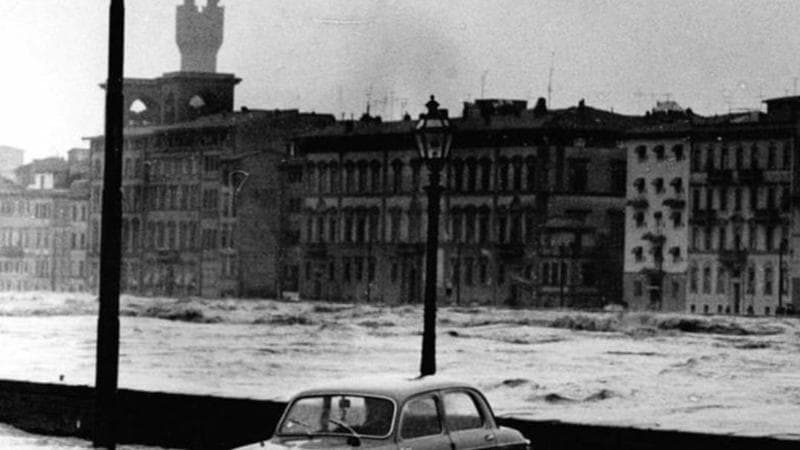
This is not simply one of the many commemorations marking the 60th anniversary of the Florence flood, but an unusual journey through devastation, solidarity and recovery. For the flood of 4 November 1966 was one of the events that shaped the history of cultural heritage conservation, in Italy and beyond.
The mayor’s appeal
A few days after the floodwaters struck, Mayor Piero Bargellini issued an appeal: “The whole world is being called upon to help Florence, so that Florence may once again belong to the whole world.”
An entire community — local, national and international — mobilised, using their bare hands to rescue from the mud the papers of religious, public and private institutions, publishing houses and businesses, as well as documents from the State Archives: six kilometres of shelving and 40,000 bundles of records.
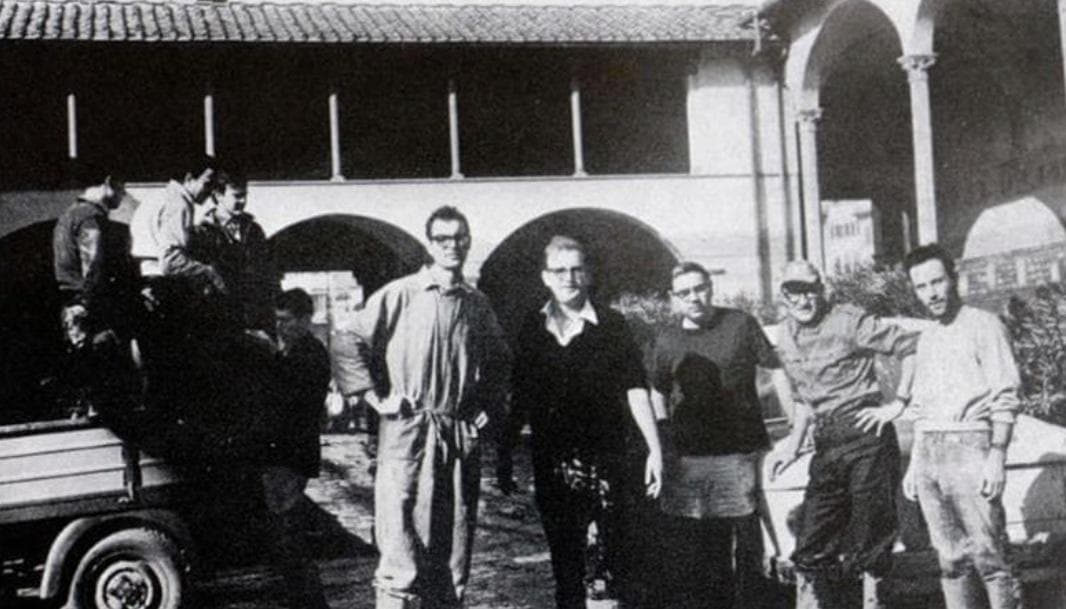
Above all, there were the 300,000 volumes of the National Central Library. Housed in a building on the banks of the Arno, it had been overwhelmed by the surge of water and mud that swept through the Santa Croce district that morning. In the square of the same name, the water rose to a height of six metres.
One of Rome’s best-kept secrets
In the garden of ICPAL — once Rome’s Botanical Garden and now one of the city’s best-kept secrets, tucked away behind Via Nazionale — black-and-white photographs unfold across panels divided into four sections, accompanied by contemporary texts by journalists and other participants in the events.
They are images captured in the midst of an emergency, yet they possess extraordinary aesthetic — and, I would say, moral — power. Five hundred volunteers rushed to help in the storerooms and among the shelves of the National Library and State Archives. The military command had been able to send just 50 soldiers.
A human chain of arms and hands
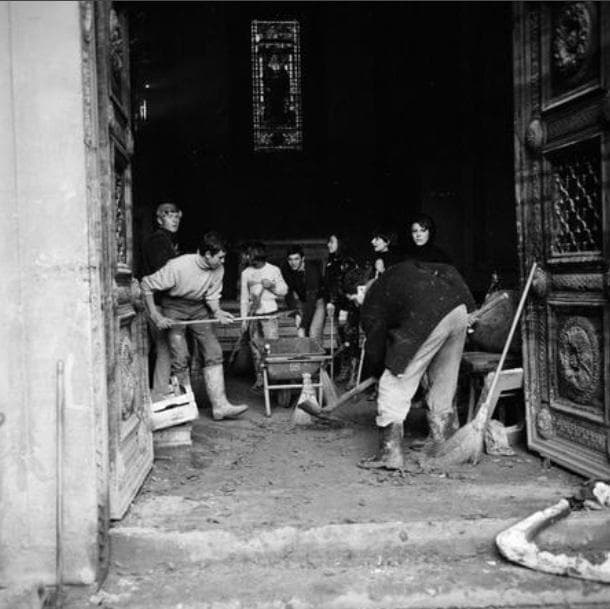
In the photographs, young men and women in rubber boots and clothes stained with silt — the so-called “Mud Angels” — form a human chain, passing from hand to hand what look like dripping bricks.
They are, in fact, files and books. Modern, old and ancient — even medieval codices and manuscripts. Among them were the 56 choir books belonging to the Opera del Duomo, from Santa Maria del Fiore, their 350 illuminated miniatures soaked in filthy water.
The young volunteers smile proudly, even as exertion and exhaustion show on their faces: once waterlogged, a book could weigh 40 or 50 times its normal weight.
A tragic act of mercy
That “Florentine epic”, as the writer and journalist Guido Gerosa called it, looks like a tragic act of mercy, akin to pulling earthquake victims alive from the rubble.
Instead, it became the most extraordinary rescue of cultural heritage ever undertaken in Italy. Millions of pages were rinsed in hot or cold showers, disinfected, fumigated and dried using drying cabinets and electric heaters — or simply laid out in the sun.
Army trucks carried this “rubble” to different parts of Italy. Between 13 and 26 November, 21 trucks delivered some 67,000 volumes to Rome. The Institute for the Pathology of Books had just six employees: two chemists, two biologists, a hygienist and a technologist. There was a shortage of equipment and expertise. What was needed were arms and hands.
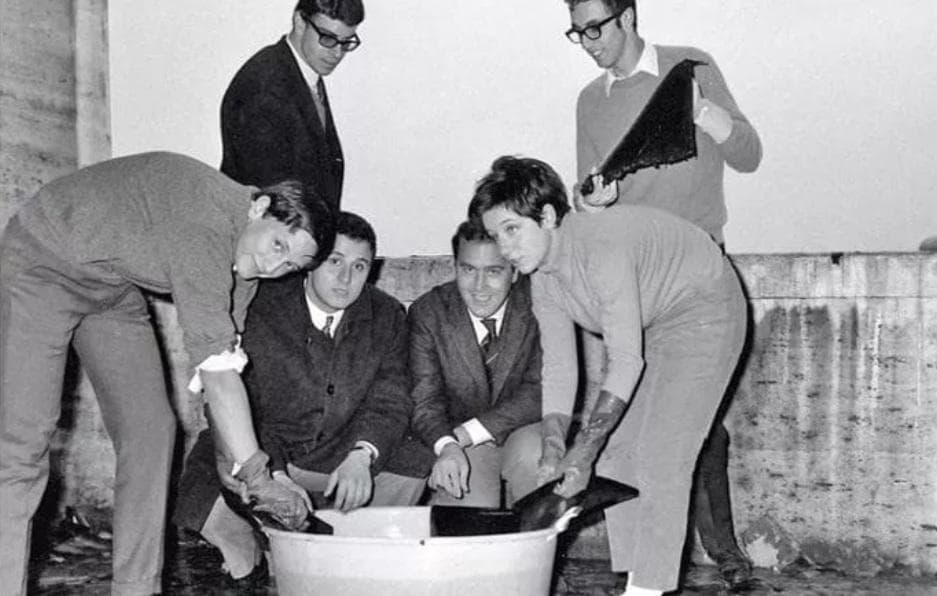
Once again, an appeal went out to students, and they responded enthusiastically. The long-haired teenagers of Rome’s secondary schools — as many as a thousand a day — gathered at the Palazzo della Civiltà del Lavoro “wearing large rubber aprons, caps, overshoes and gloves, looking halfway between a butcher and a surgeon”, as Francesco Belli recalls in the exhibition’s final section, which also features witnesses interviewed and photographed today.
Bound by strict hygiene rules intended to prevent infection, breathing in the smell of mould and wet paper, they carried out the first stages of the rescue under the supervision of restorers and experts: misting, disinfecting, scraping with sponges and scrapers, removing valuable bindings...
Restoration continued for years. The experience gained after the flood helped develop and refine techniques, methodologies, research and training in the field of conservation. Today, ICPAL is a leading institute that also runs a degree course qualifying graduates to work professionally as cultural heritage restorers.
A moving exhibition
The exhibition is small and simple, but moving and even joyful. It tells the story of a young country that mobilised to save its past while imagining its future.
It is a lesson that remains relevant today, in a world disrupted by climate change, where natural disasters are no longer exceptional events but increasingly frequent and destructive catastrophes.
And it reminds us that a book is not just another object, however obsolete it may seem, but a treasure.
The translation of this article was reviewed by a Language Service Provider