
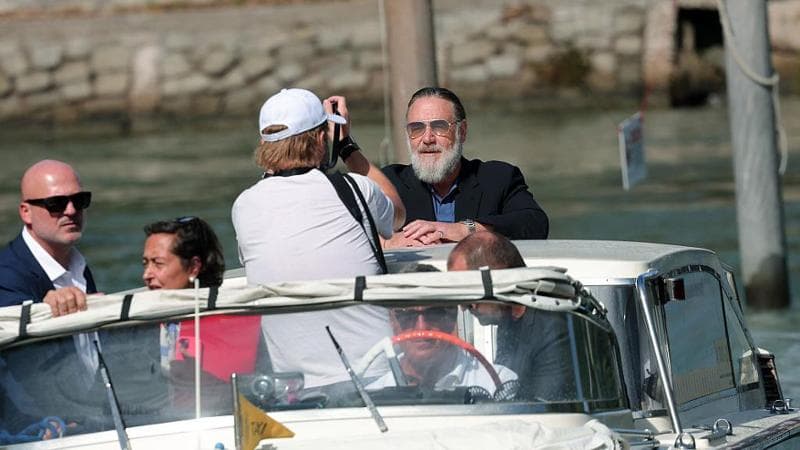
VENICE — Russell Crowe was seven years old when he first set foot on a film set. His mother worked in film catering, and when the production needed a young boy as an extra, Crowe got the part. He was also seven when he was given his first guitar. Ever since, music and cinema have been equally important to him.
Now 62, with around 80 films to his name, an Oscar for his performance as Maximus in Gladiator, and experience directing short films, music videos and feature films, Crowe has come to the Venice Film Festival to present What Love Builds, a documentary — or perhaps a self-portrait — that he wrote, directed and produced, focusing on his relationship with music.
“I started working on this documentary about 15 years ago. I thought it wouldn’t take long to finish, but there was always another musical commitment coming up. So I kept waiting for that to pass, then the next thing, and in the end 15 years went by. When we finally sat down to edit it properly, we found ourselves with more than five million metres of film. Trying to extract a narrative from all that material was a monumental task.
“But I knew exactly what I wanted to achieve: to answer the question I’m asked most often, which is what the difference is between music and film. The film tries to explain how deeply intertwined the two are. Ultimately, there is no difference. The only difference is the relationship with the audience”.
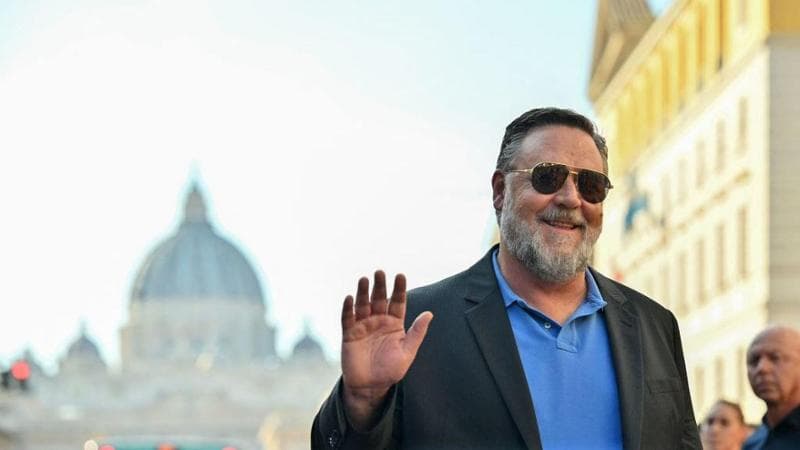
“The documentary tries to explain everything I do as a director: I know how to guide an audience, even when the audience isn’t physically present. I have a kind of intuitive understanding of what an audience perceives and what it will take away from each individual performance. It’s an approach that comes from my background in rock and roll and theatre. It’s almost a necessity, a way of working that, in a sense, I’m a slave to.”
Part concert film, What Love Builds includes archive footage of Crowe performing with 30 Odd Foot of Grunts, as well as more recent material featuring The Indoor Garden Party, with whom he has also performed in Italy, in spectacular settings including the Colosseum and Piazza del Campo in Siena.
But it is also partly a confession, with the Australian actor telling his own story. There are moments of great intimacy, as when he describes the difficulties of coping with fame and the paparazzi’s invasion of his private life, while at the same time admitting that some of the best photographs he has with his children are precisely those “stolen” by photographers perched in the trees around his home.
And although the film focuses primarily on his musical career, his work in cinema inevitably makes an appearance, beginning with his first film, the 1990 romantic drama The Crossing.
Asked about his relationship with Hollywood, Crowe says: “It’s funny to think that all this was the result of some conscious choice, you know? In reality, I simply took opportunities as they came along. I didn’t have a specific plan — and I still don’t — I simply follow whatever feels right to me.
“Filmmaking is where I really feel at home. I wouldn’t change anything about my career. Even in the darkest moments, I learned so much. I’m incredibly happy to still be in such demand at 62. I work exactly as much as I want to, and that’s amazing.
“I’m the kind of person who thought, ‘I’ve got the opportunity to make a film, so I’m going to make sure it’s good,’ because I wasn’t at all certain I would get the chance to make a second one. I think one of the reasons I’m still working is precisely that genuine approach. When I have to get up at 4.30 in the morning to go to the set, I know exactly why I’m doing it. I know why I’m getting up at that hour, and that motivates me and keeps me going.
“I feel very sorry for actors who agree to work on projects they don’t believe in, or play characters they don’t connect with. I really don’t know how you find the strength to get up at that hour unless you have a deep love for what you do.
“I’m really happy with the way things are going, and I can’t wait for you to see projects like Unabomber, the Highlander film, and there’s another major project I’ve just finished. You’ll probably see another big title too. I’m constantly amazed that I get to do this job. I wouldn’t do anything else, because I love it.”
Crowe also returns to his Italian roots. A few years ago, I discovered a strong connection to Scotland, going all the way back to the time of Robert the Bruce, particularly through the Frasers of Lovat clan. But there’s more to my family history: I also discovered my Italian roots through an ancestor named Luigi Ghezzi. He later met an Irish woman, and it was only recently that we discovered who she was".
Perhaps that is one reason — along with the bond he has always had with Italy — why Crowe is so pleased to be giving What Love Builds its world premiere in Venice.
“As we were getting towards the end of the edit, I thought how wonderful it would be to bring it to the Venice Film Festival. I’ve attended many festivals, but this is the most beautiful. It’s as chaotic as the others, but the audience is different; they appreciate cinema in a different way. We had lots of invitations, including from Shanghai, but I’m happy I brought it here. I showed it to Gabriele Muccino and asked him what he thought. I couldn’t think of a better place to give such a personal film its world premiere.”
Asked what dream remains after a career like his, Crowe replies: “I still have plenty of dreams I want to fulfil. All things considered, I think I’ve only scratched the surface of what I can do with film and music. But as the years go by, I often find myself wondering how many summers I have left. I love spending time with my children and doing what they call the European tour with Dad. So my dream is to spend more time with them than I do on film sets.”
The translation of this article was reviewed by a Language Service Provider