
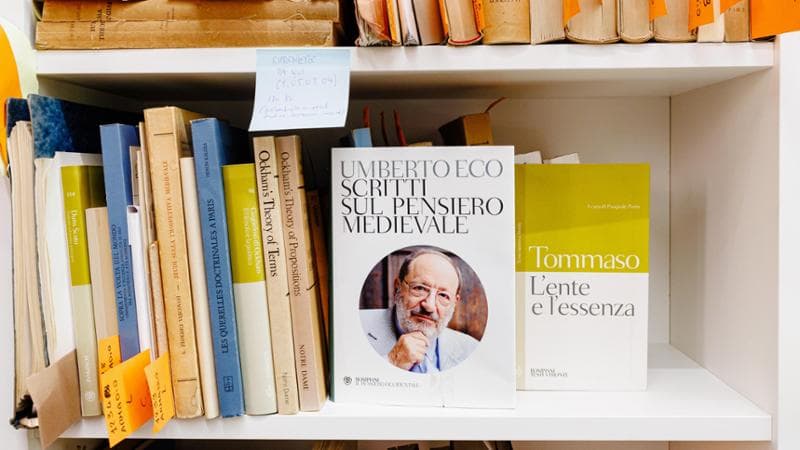
BOLOGNA – It is not a museum, not an archive, not a collection. Eco’s library creates an atmosphere. It is a merry-go-round to climb aboard, a dance in which the rhythm of the professor’s immense curiosity does not overwhelm the fortunate visitor’s own, but sets it alight. Since 1 July, the library has made its home in the 20th-century wing of Palazzo Poggi in Bologna, at the far end of Via Zamboni, with its entrance overlooking Piazza Puntoni.
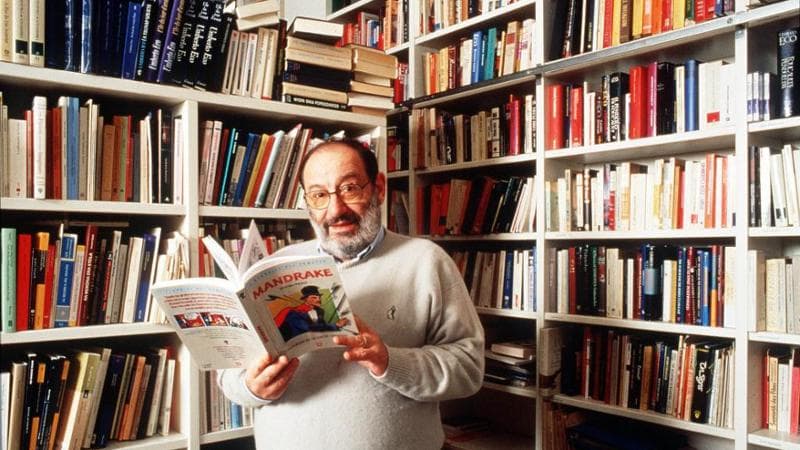
A 900-metre tower
There are 32,000 volumes. Laid flat, one on top of another, they would form a 900-metre tower, taller than the world’s highest building in Dubai. His own Tower of Babel — one that can only be imagined, because the books, volumes and periodicals, first editions and original comic books, his old school textbooks and serialised novels, treatises on Thomism, esotericism, conspiracy theories and the Kabbalah have all been arranged — or rather transplanted — into a floor plan and onto shelves that reproduce their original order, whatever that may mean.
Umberto Eco regarded the library — “our vegetal memory” — as a living place, somewhere to discover, through the divining rod of chance, what one does not know. He followed Aby Warburg’s “good neighbour” rule: you do not take the book you were looking for, but the one next to it, because “that is the one you actually need”.
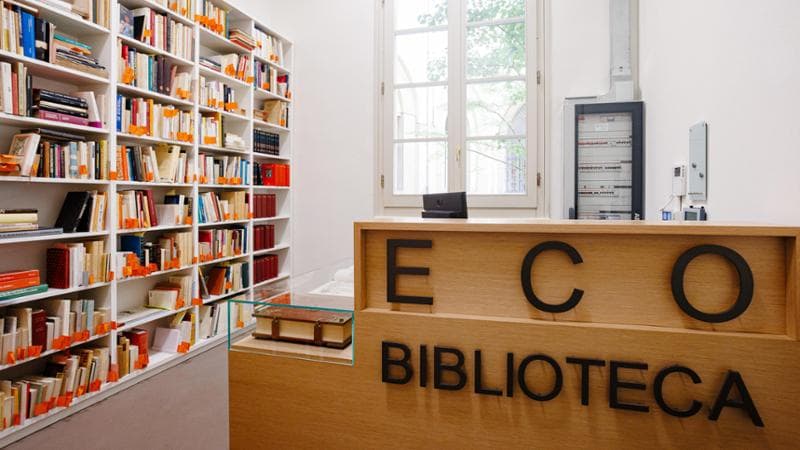
The rules for following that rule remain something of a mystery, a mixture of personal taste and knowledge, like recipes in which the interpretation of “a pinch of salt” can change everything. And yet, just as some people have perfect pitch, the professor’s perfect eye proves contagious, sweeping away the human need for the comforting order of matching series.
Mapping the library in his Milan home took months and months. The work was carried out by the Alma Mater — the University of Bologna — through art historian Francesca Tancini, working alongside Professor Riccardo Fedriga, explains Ilaria Bortolotti, the curator and guide to the “Bibliolandia” in Piazza Puntoni: a paper garden in which lost colours, forgotten covers and vanished titles bloom again.
There is a faint sensory dizziness to it, rather like being in an art gallery: here, the books may be looked at, but they cannot be touched or leafed through.
The vertigo of lists
And so, almost hypnotically, the visitor is both lulled and overwhelmed by the “vertigo of lists”, of which Eco was both an inveterate devotee and an agent provocateur. The nominalist vertigo of proximity, correspondences and distances; the bizarre Kama Sutra of volumes arranged in so many different positions, rather than merely standing upright in the conventional pose, proudly displaying their spines.
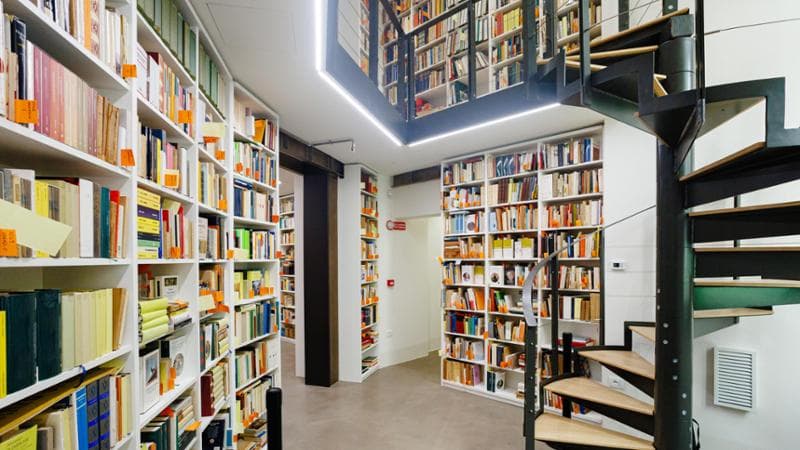
Every glance brings another bout of vertigo.
Misteri egizi (Egyptian Mysteries, Gruppo Editoriale Fabbri); Nel mondo dell’incredibile (In the World of the Incredible, Reader’s Digest selection); Storia dell’escatologia (A History of Eschatology); Pavel Florensky’s The Pillar and Ground of the Truth; LSD, la droga che dilata la coscienza (LSD, the Drug That Expands Consciousness); L’astrologia, storia e metodi (Astrology: History and Methods); Edmond Locard’s Manuel de technique policière; Renier’s Il Gelindo; Cohen’s Everyman’s Talmud; Wood’s Bible Animals; Peter Kolosimo’s Terra senza tempo (Timeless Earth); Crowley’s Magick in Theory and Practice; Evola’s Revolt Against the Modern World; René Guénon’s L’Archéomètre.
The occult room
We are in the first room, devoted to the occult and religion. Then comes the room for semiotics and the theory of language, followed by walls of philosophy — ancient, medieval, modern and contemporary — with volumes extending across the entire upper floor, which tantalisingly promises more but refuses to yield its secrets: it is not open to visitors.
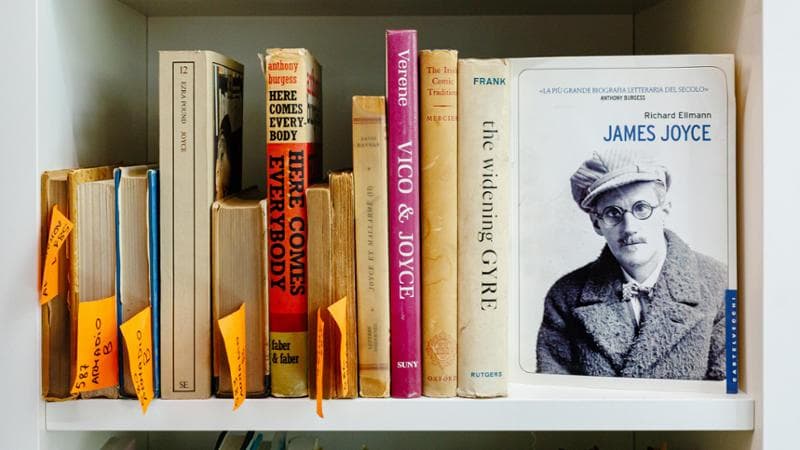
Then comes literature — Italian, French and German — with the beloved Joyce given an entire column to himself, as is Linus. There are Anglo-American writers, Russians, Iberians and South Americans, and poetry. From there, the visitor moves into the realm of non-verbal languages: art history, communication, advertising, catalogues, cinema and television.
The journey ends with comic books, Eco’s own works — 2,000 editions in every language — and 600 books about him, while the academic theses have yet to be catalogued.
Amid the dizzying array are Diabolik, Tex Willer, Il Balilla, Satanik, Mickey Mouse comics, Goldrake — not the UFO robot but the playboy detective — Mafalda, the Smurfs, magazines including Il Mago, Mad and Comics, Spider-Man, Watchmen, Puzz’s ordinary comic strips, Mandrake, Dick Tracy, Pogo, Al Capp, Cino e Franco, Jacovitti’s Joe Balordo, Cuore and Cipputi.
Among Eco’s own works is a pirated edition of The Name of the Rose, published in the Soviet Union and passed off as an erotic novel on a suggestive cover showing a naked woman beside a predatory-looking monk.
There is also an enormous volume by the visionary Jesuit Athanasius Kircher, a master of intellectual creativity who, in the 17th century, was capable of imagining lands, animals and peoples — and having them drawn.
Just the way Eco liked it. He used to say that as a child he had written many books: “I never got beyond the first chapter, but I illustrated every one of them from beginning to end”.
A Kama Sutra of essays and novels
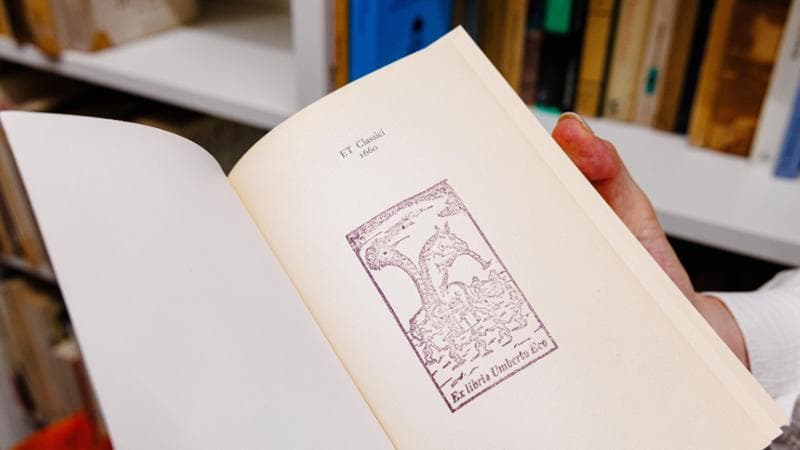
Today, his library preserves the affectionate physical tussle with the page: scribbles, sketches, dog-ears — so many dog-ears — underlining in pen, coloured ink and pencil, notes in the margins, inserts, articles, blank sheets and bookmarks.
There is a great deal of joy among his companions in adventure. The vertigo becomes sheer fun with White Fang, John le Carré, Twain, Scerbanenco, Mondadori crime novels, the Urania science-fiction series, Latimer’s Sinners and Shrouds, Sherlock Holmes, Kipling, Ursula Le Guin, Henry James, Tolkien, Fleming, Agatha Christie, folk tales — two volumes of the Edison edition — Carolina Invernizio, all the serial novels of Francesco Mastriani, famous for The Blind Girl of Sorrento and every bit as prolific as Invernizio, Edmondo De Amicis, Renato Serra, Salvatore Gotta, Eliot, Rex Stout and Salgari in weighty illustrated volumes.
Then Siciliano, Sgorlon, Siti, Serra, Calvino, Zavattini, Wu Ming, Fortini, the magazine Il Menabò, Cristina Campo, War and Peace in Mondadori’s Medusa edition, Jacobus de Voragine, Brecht, Folengo, Hugo, de Maistre, Vasari, Musil, D’Annunzio, Turgenev, Tirso de Molina, Don Quixote in the original Spanish, Kundera, Tasso, Gabriello Chiabrera, García Márquez, Inspector San-Antonio, Lear’s Book of Nonsense, Günter Grass and Ende’s The Neverending Story.
So far, 150 people have visited, and two questions are said to crop up again and again. Visits must be booked in advance.
The first is the anxious question of how many of those 32,000 books the professor had actually read. The second is a debate over the libertine arrangement of the volumes: double rows, books lying flat, books piled on top of one another, with Nero Wolfe gazing down on Beckett.
Encyclopaedias, dictionaries, The Semiotics of Performance, Gillo Dorfles on kitsch, Gombrich’s Art and Illusion, the McLuhan galaxy, William of Ockham, Naissance de l’écriture: cunéiformes et hiéroglyphes, Il concetto di dialettica in Aristotele, the works of Freud, Bartezzaghi, Peirce in the original edition, Gérard de Nerval, St Anselm, Reichenbach, Books and Their Makers During the Middle Ages, The Travels of Marco Polo.
The meaning of any list lies in what each of us can and wants to find in it, amid this silent dance of works — drawn by knowledge, curiosity, colour harmony or simple amusement to one of the threads connecting these 32,000 guests.
The game is to pull at one of those threads, through the boundless anarchy of free associations, adding our own memories, studies or fantasies along the way.
Umberto Eco played the recorder. Here, a Pied Piper is still making his books dance.
And the music is for everyone.
The translation of this article was reviewed by a Language Service Provider