
“I make movies for the audience, not for the critics.”These were the words of director Ridley Scott some time ago, speaking out after being snubbed for an Oscar yet again by the Academy. Now, following four nominations across an epic 50-year career—for Thelma & Louise, Gladiator, Black Hawk Down, and The Martian—he is finally set to receive an Honorary Oscar at the upcoming Governors Awards this November.
“It’s about freaking time!” Scott exclaims when we speak. “While I appreciate the recognition, for me, commercial success, cultural longevity, and ensuring hundreds of my crew members have a job matter far more than a trophy. But, obviously, I’m pleased.”
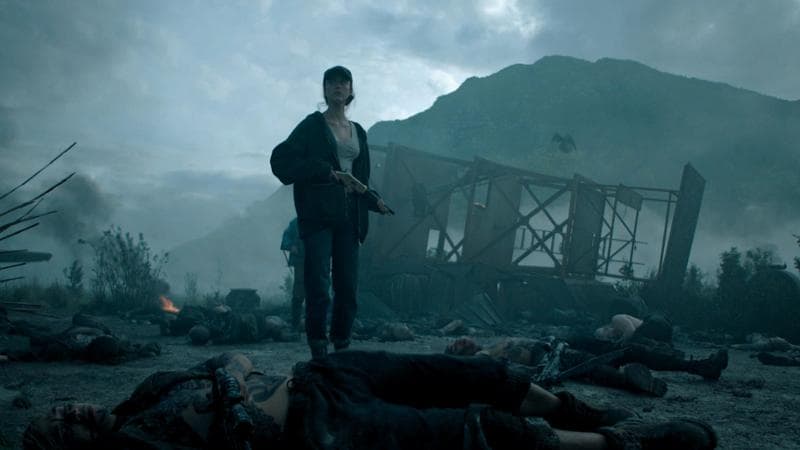
We meet the veteran filmmaker to discuss his latest project, The Dog Stars, adapted from Peter Heller’s novel and starring Jacob Elordi, Margaret Qualley, and Josh Brolin. In theaters since late August, the story takes place nine years after a super-flu pandemic has wiped out most of humanity.
Hig (Elordi) lives with his aging dog Jasper at a small rural airfield north of Denver, Colorado. He shares the space with Bangley (Brolin), a gun enthusiast who had been prepping for the apocalypse his entire life.
What drew you to this story?
"It’s a story about loss, solitude, and the fragile beauty of a world on the brink of vanishing. An intimate, adventurous journey—a love letter to nature and life when all seems lost.”
How do you maintain narrative tension when the threat comes from desperate human survivors rather than monsters?
“Scaring people is actually very difficult. A world like the one in The Dog Stars genuinely terrifies me. When I talk about scaring people, I don't mean monsters lurking in the dark, jumping out from every corner. That’s a cheap trick. True fear is psychological—you have to approach it like a horror film, watching people slip on a banana peel. It’s brilliant when it creeps in organically, when you start sweating a bit and your heart rate spikes. That’s the key. It’s visceral, instinctual.”
Is there a message of hope amid the post-pandemic desolation?
"I hadn’t read the book, but the script was outstanding. To me, it was a dystopian narrative without the zombies; I had no interest in treading that repetitive ground. I saw this story as being about a world that has crossed the point of no return—much like the moment we find ourselves in today regarding global warming. We went through a perilous ordeal with COVID, alongside financial collapses and endless political bickering over who’s right and who’s wrong… It’s shocking how foolish human beings can be.
"If you stack two or three more catastrophic events on top of that, we lose control. Suddenly you're staring down the end of the world, with people running for cover to grab whatever they can. It can happen. I think the most dangerous thing right now is that no one is paying attention to people's desperation and hardship. Without wanting to sound pessimistic, I just hope it isn't too late.”
Why did you choose to shoot the film in Italy?
"Because they offered me a fantastic tax incentive—there are no big secrets there! The script was originally written with the mountains of Colorado or Canada in mind, but after thinking it over… the Dolomites were the better choice. The food is incredible and the people are warmer. I only had one firm requirement: the landscape had to feel entirely credible. In all my films, the setting is a character in its own right; it’s the stage upon which the actors interact. No story can survive without a meticulously constructed environment.”
How has your creative process evolved over the years?
"My job is always a gamble, but within that gamble, I have to be completely decisive. Otherwise, I’m wasting massive amounts of time and money. But if you don't take risks, you don't get rewards. I don't dwell on past triumphs or failures. The moment I finish one film, I launch straight into the next. I loathe the word ‘retirementì’—it sounds like a death sentence. I despise the thought of stopping, so I’ll keep going as long as my health holds up.”
One of the film’s central themes is that what is lost can be found, and enemies can become allies…
"Yes, and good things can emerge from terrible situations. If that weren't true, we’d be back in the age of the dinosaurs. I don't believe the planet will ever be entirely uninhabited; there will always be survivors. Right now, there are eight billion people on Earth, and we simply cannot sustain them all. Look at the tragic situation in Sudan, the thousands of unhoused people in Los Angeles, the severe food and financial insecurity everywhere.
"Wars, invasions, bombings—without wanting to sound overly dramatic, it reminds me of Germany in the aftermath of World War II, where nothing was left standing, as if an atomic bomb had dropped.”
If you could speak to a young Ridley, what advice would you give him? “Trust your instincts, without regrets. Just because you think something you’ve done is a load of bollocks doesn't mean it will be seen that way forever. Learn from the bollocks.”
Which directors have shaped your work?
“Stanley Kubrick above all, but also David Lean, Akira Kurosawa, Ingmar Bergman, John Ford, and Sam Peckinpah. Artists, every single one of them, each with their own ‘trick.’ Stanley was obsessed with the artistic vision; Bergman didn't give a damn about money; Sam Peckinpah loved violence—people think he invented slow motion, but he didn't. That was Kurosawa in Seven Samurai.”
And what is your trick? "A multi-camera setup. It allows me to shoot epic scale at an astonishing pace. I picked up that speed from directing commercials; advertising was my film school, and it taught me how to move fast. Making a movie is a tightrope walk, balancing art and commerce. Despite my age, I remain fiercely practical—I always come in under budget.” Is it true you first dreamed of directing as a young boy?
“Yes, it was my secret ambition. I thought it would sound too foolish to tell my parents, because coming from where I did, it was unthinkable. The film industry and the theater were like the dark side of the moon. I never truly believed it was a viable path.” When did your interest in art begin? “The only real talent I possessed from a very early age was drawing. I used to spend my time painting while other kids went out dancing. My parents thought I was deeply strange. But I got accepted into the Royal College of Art, which was unequivocally the finest art school in the world. That’s where I met David Hockney, a genius on par with Matisse. I couldn't compete with him, but I wasn't half bad myself.”
Do you still sketch?
"I’m doodling as we speak. I draw on whatever is in front of me, constantly. When I’m not working, I paint all day. I get better at it every day. Shooting a film is just like painting— I treat the camera as my paintbrush”.
What are you working on next?
"Treasure Island. The Bee Gees biopic is on the back burner for now. Treasure Island has a brilliant script by Jack Thorne, who wrote Adolescence. I’m in a good place with it. I’ve cast Hugh Jackman as Long John Silver”.
You turn 89 on November 30. Is there anything left on your bucket list?
"I’d love to direct a musical in the style of Bob Fosse, whom I unfortunately never had the chance to meet. All That Jazz and Cabaret are the absolute pinnacle of the genre, largely because they are anchored in extraordinary historical contexts. But given that my mother lived to be 98, that’s a dream that is still well within reach."
You own an estate in Provence. What does that place mean to you?
"It’s my sanctuary. I’ve been going there for thirty years. I bought it as an old farmhouse and gradually turned it into a gem. Today it’s a family business—we produce wine, and we’re actually quite good at it.” Is winemaking similar to directing? ”Absolutely. Selecting the chemist and the winemaker is just like casting a film. I have a fantastic "wine director"—I’m lucky, he creates something truly special.”
The translation of this article was reviewed by a Language Service Provider