
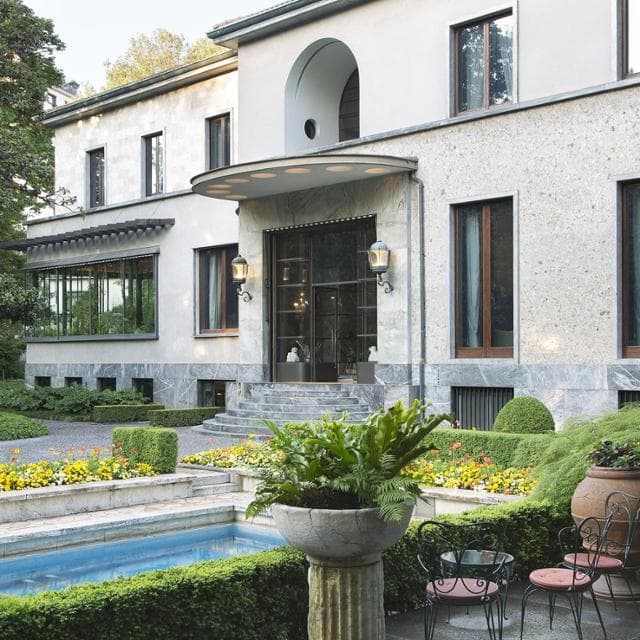
MILAN — Two hundred lire for every week of delay. That was the fine stipulated in the contract if the grand reception room of a house just steps from Milan’s Duomo and La Scala opera house was not completed by September 15, 1876.
Gian Giacomo Poldi Pezzoli, a Milanese nobleman and passionate art collector, had assembled some of the finest sculptors, cabinetmakers and fresco painters from the Brera Academy of Fine Arts, one of the world’s most prestigious art institutions. He had entrusted the project to Giuseppe Bertini.
The original vision
The contracts, signed in March of that year, reveal the full extent of the splendour Poldi Pezzoli envisioned. The room was intended to house the most precious pieces in his collection, including Renaissance masterpieces, and its surroundings had to be worthy of the works on display.
The walls were to be decorated with frescoes and draped in damask fabric, while paintings would rest on pedestals to create a more intimate atmosphere. Above visitors’ heads would rise a gilded wooden coffered ceiling, from which the room would take its name.
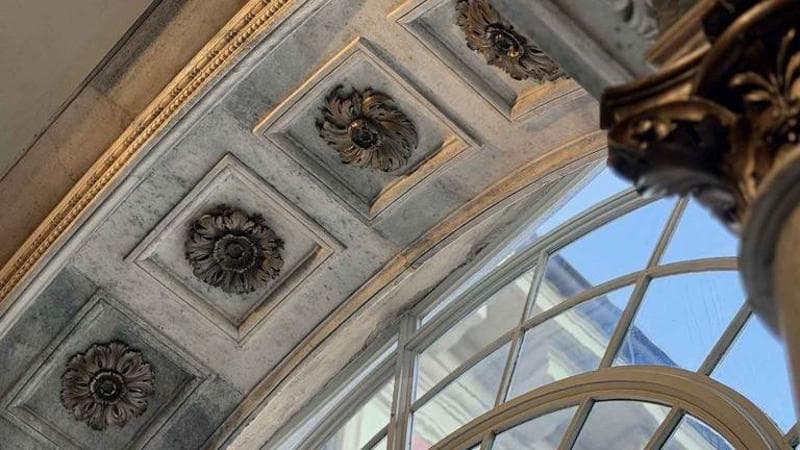
Natural light would flood in through a large Palladian window overlooking the palazzo’s garden. Designed with columns topped by bronze capitals and rosettes decorating its central arch, the window was to be made from coloured marble. Samples of green marble from Varallo, purple-veined marble from Siena, and marble from Carrara and Candoglia were specially transported to Milan by rail.
From Botticelli to Raphael
Despite the contractual penalty, construction dragged on well beyond the agreed deadline. The house museum, with works by Pollaiolo, Mantegna, Botticelli, Raphael, Piero della Francesca, Tiepolo, Canaletto and Hayez, alongside extraordinary collections of clocks, Murano glass and Meissen porcelain, finally opened to the public in 1881. Poldi Pezzoli, who had died in 1879, never lived to see his vision completed.
The restoration
Today, 150 years after the conception of this pioneering house museum, which went on to inspire institutions around the world, including the Isabella Stewart Gardner Museum and the Frick Collection in the United States, the Golden Room has reopened following an ambitious restoration that has transformed the museum’s most emblematic space.
The €250,000 project was funded by the World Monuments Fund, the international private non-profit organisation dedicated to preserving some of the world’s most valuable cultural heritage sites, which opened its Milan office this spring.
A return to its origins
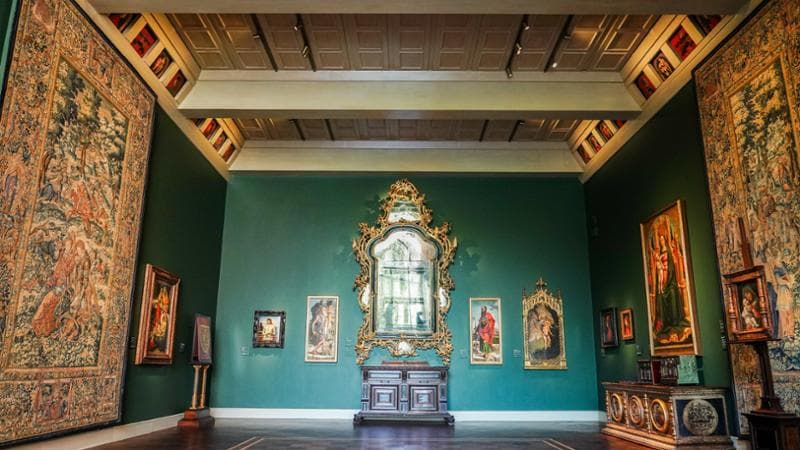
The false ceiling installed in the 1970s has been removed, restoring the room’s coffered ceiling. This time, however, it is ivory rather than the gilded version of the 19th century.
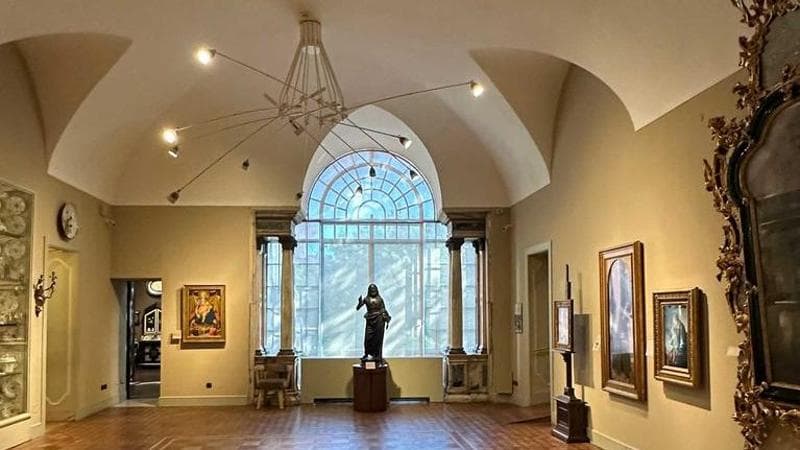
The imposing architecture of the window designed by sculptor Lodovico Pogliaghi, creator of the main bronze doors of Milan Cathedral, has also been brought back into view.
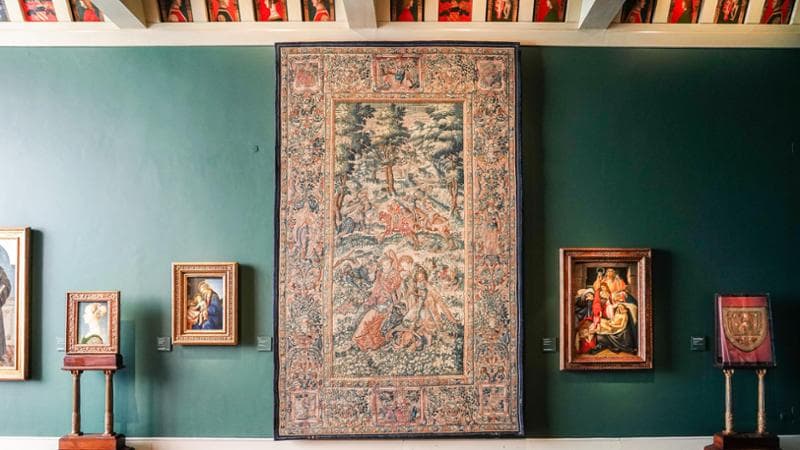
And there is more. The room has regained its warmth thanks to dark green walls that echo the marble of the Palladian window. The wooden mirror frame with Murano glass has been restored, while two 17th-century tapestries are once again on display, along with 40 of the 98 decorative ceiling panels from the postwar redesign, which had been lying in storage for years.
What the video inspections revealed
“The work began with a study of the archival documents,” explains Alessandra Quarto, director of the house museum and the driving force behind a programme to revitalise its historic interiors that began in 2023.
The archives yielded the original contracts, payment records and period photographs documenting the room’s many transformations.
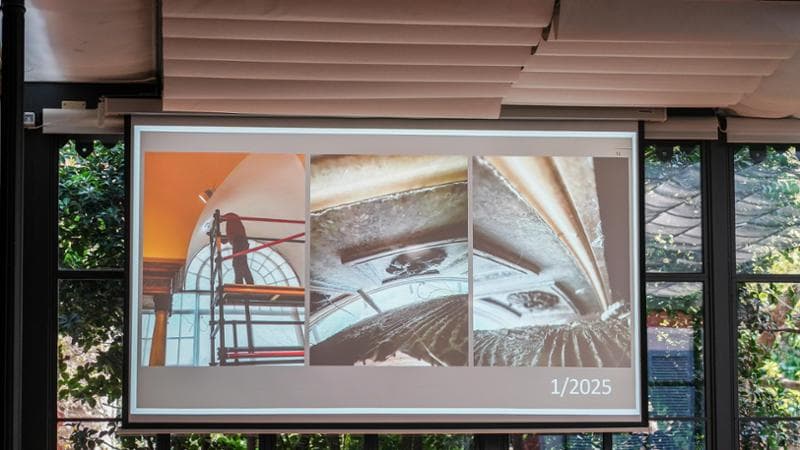
“Last June, we carried out video inspections to establish what remained of the original structure above the false ceiling installed in the 1970s,” Quarto explains.
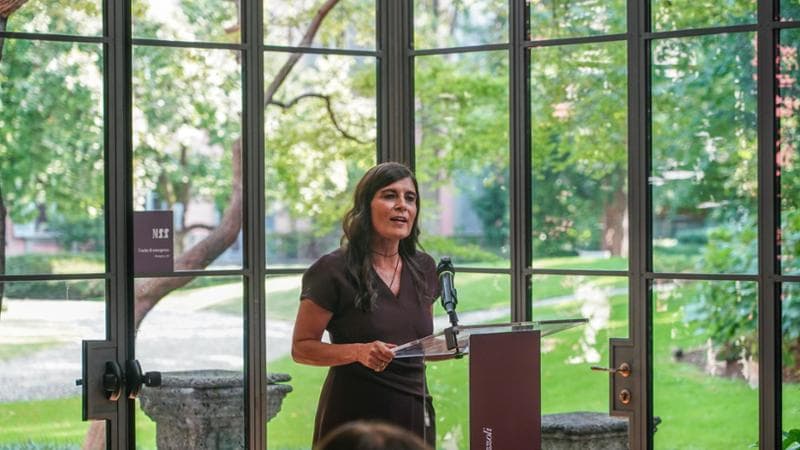
The inspections revealed that the wooden ceiling created after the war by Fernanda Wittgens, the art historian who saved numerous Milanese masterpieces from wartime bombing, had been completely demolished.
“But the marble arch of the window, complete with its bronze rosettes, was clearly still there and had survived in excellent condition,” the director adds.
With that discovery, the restoration could begin.
A history of transformations
Over the past 150 years, the Golden Room has undergone several transformations.
The first came after the bombing of 1943, which destroyed part of its 19th-century interior. Years of restoration work and debate over how the museum should be rebuilt followed, until it finally reopened in 1951 with an interior designed by Wittgens herself.
The destroyed fireplace was replaced with a similar one borrowed from Sforza Castle, while the coffered ceiling was reconstructed and decorated with 98 painted panels donated by the Italian state as compensation for the damage the museum had suffered.
In 1974, the room underwent another transformation. Reflecting the prevailing thinking of the time, a more restrained design was chosen to give greater prominence to the artworks on display.
The ceiling was therefore demolished and replaced with a plasterboard structure forming a shallow vault, one metre lower than the original ceiling.
The redesign came at the expense of part of the window, the decorative ceiling panels — half of which were installed in the galleries devoted to the Lombard Renaissance — and the tapestries depicting The Adventures of Amadis of Gaul by Françoise Spiering, which had adorned the room since the late 19th century.
Now, at last, the Golden Room has regained its original proportions. And its magnificent marble window, hidden from view for half a century.
The translation of this article was reviewed by a Language Service Provider