
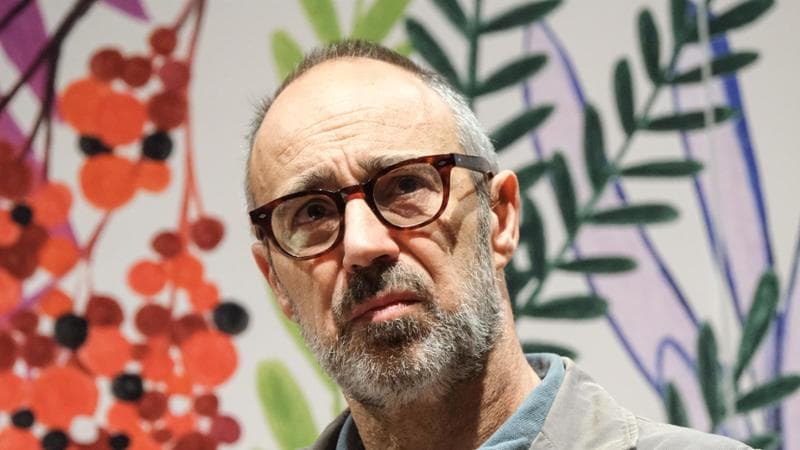
ROMA – Niccolò Ammaniti says birthdays do not measure time; they bend it. Because they have so much to do with nostalgia, they make time swing forwards as well as backwards, stirring imagination and the future as much as memory and recollection. Ammaniti also says that until fairly recently he would never have agreed to an interview like this, to mark his roaring 60th birthday, which he celebrated on 25 September.
Why wouldn’t you have agreed to it?
“Perhaps because it’s only as you get older that you become willing to talk about getting older. More than turning 60, what strikes me is that it’s been 30 years since my first book, Branchie, was published — another anniversary that falls in 2026. I don’t feel those 30 years at all. It seems like I only started writing the day before yesterday.”
Is there a moment when you realise you’re getting old?
“It happened to me five years ago, after a long and exhausting period working as a director. I kept saying to my wife, ‘I’m getting old,’ and she’d say, ‘Oh, stop it. If you’re old, then I’m old too.’ That was when the split between the two Niccolòs began.”
Tell us about them. Who are these two Niccolòs?
“The young Niccolò still gets excited and has fun, but he’s constantly watching and keeping tabs on the ageing Niccolò, ready to catch him out whenever he makes a mistake or forgets something. I’m becoming my own carer. I live with young Niccolò perched on my shoulder, this ruthless observer. And yet I know this isn’t old age yet. I’ll really be old when the two Niccolòs finally become the same person.”
If we may say so, your latest novel, Il custode (Einaudi Stile Libero), sounds as though it was written by the 20-year-old Niccolò.
“I really could have written it when I was young, if I’d had the courage. Back then, though, I wrote stories in which you eventually resurfaced. Il custode is a subterranean, mythological book. You dig down to find what connects us to the past and to tradition.”
Is Medusa the monster we carry inside us? She certainly turns people to stone in the book.
“I’m lucky: I dream a lot, and I know that mythology lies at the heart of every story. And I remember everything. I once dreamt of a nanny with a zip down her back. She opened up and there were other creatures inside her. Metamorphosis and fusion have always fascinated me, not just as a writer.”
The unconscious seems to play a big part in all this. Perhaps your father, the psychoanalyst Massimo Ammaniti, does too? Is it a coincidence that you have both devoted so much attention to young people?
“They’re two fairly parallel paths, but it wasn’t deliberate. I chose to write about young people as an exercise in memory. I think nostalgia is something we can’t do without — young people even more than the old. And it’s an intensely poetic feeling.”
At 60, how do you see the future?
“With fear. But at this point in history, that’s true at any age. With wars, hunger, a climate spinning out of control and poverty, it’s difficult to imagine what the future holds.”
So is it better to write?
“Writing — and reading, of course — can save your life and help you carry on. I’ve never understood what lies at the heart of the mystery of writing: why a story takes shape in a particular way and becomes that story rather than another. I keep a very close watch on my own psyche, which swings between intense depressive moods and rare moments of euphoria, almost always for no apparent reason. I enjoy imagining stories more than I enjoy actually writing them. Writing is a battle, especially when I’m down.”
Have the years made you more forgiving or more demanding of yourself?
“I’ve become much less critical, calmer and more methodical. When I was young, I wrote in a scattered way. I’d make things and unmake them, start different plots at the same time, piece them together and then pull them apart again. Now, I think I can write stories that are deeper, stories that feel more right for where I am when I write them. And I know I’m not trying to recreate what I’ve done before. I don’t want to repeat myself.”
You’ve always kept your distance from public debate. Why?
“I hardly ever get involved. My vocation is storytelling.”
As the years go by, the masters we’ve encountered seem to matter more and more. Let me give you just one name: Bernardo Bertolucci.
“He really was a mythological creature, and I never once heard him complain. He was full of grace. He taught me the pleasure of sharing beautiful things. Friends would get together to share films and books. These days, it seems to me that people mostly meet up to eat. Life has become the time that passes between the starter and the bill.”
Have you become a loner?
“I go out less. I don’t feel like it as much. And I miss the days when we used to mess around with the buttons on the intercom instead of our smartphones. We spend so little time together now. We’ve lost the idea that there are things we simply need, books we absolutely have to read. With Bernardo, you had homework: we had to read The Magic Mountain and The Man Without Qualities, and we had to see all the films. I think sharing beauty is the highest form of friendship — perhaps even of love.”
What do you read at 60?
“You reread a lot, partly to rediscover particular moments in your own life, which clings to books like ivy. I’ve just reread Oblomov and thought it was extraordinary, far richer than it seemed to me the first time around. Of course, some books disappoint you when you go back to them.”
Why can reading save your life?
“It’s like following in the footsteps of those who came before you, walking the same path they did. Perhaps that’s why we read: so we don’t fall off the edge.”
The translation of this article was reviewed by a Language Service Provider