
"When the seagulls follow the trawler, it's because they think sardines will be thrown into the sea." On 31 March 1995, Eric Cantona — already dubbed "King Eric" for his talent and for helping Manchester United win the league title in 1993 after a 26-year drought — delivered this cryptic statement at a press conference following his eight-month ban for launching a kung-fu kick at Matthew Simmons, a Crystal Palace supporter who had shouted abuse at him from the stands.
It is one of many bizarre moments revisited in Cantona, a documentary screening at the Rome Film Festival on 23 October following its premiere at Cannes. Directed by David Tryhorn and Ben Nicholas, the film weaves together the striker's sublime achievements on the pitch — five Premier League titles, two French league titles, 165 goals and 70 assists — with his passions for painting and acting, and the personality of a man who seemed to be at war with everyone and everything.
There are the insults hurled at France manager Henri Michel, whom Cantona called a sac à merde ("bag of shit") after being left out of the national team when he was 23; the confrontation with Marseille president Bernard Tapie ("I don't like people who use football for politics"), complete with a shirt thrown aside; balls deliberately kicked at referees, verbal abuse and middle fingers raised at supporters.
Then there are the rows with journalists and the dismissals for tackles so violent that they helped cement his reputation as football's enfant terrible — even though he received just five red cards throughout his career.
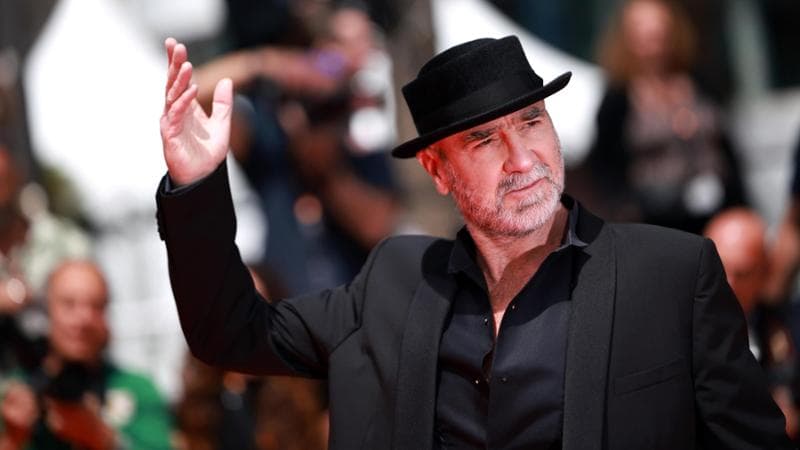
"I remember the seagulls line," Cantona chuckles when we meet for this interview. These days, he divides his time between painting and acting. Dressed in a blue checked tunic and a top hat, he is in good spirits, although his expression occasionally darkens.
"The club was determined to make me say something, and that line came into my head. I think it was the greatest press conference ever. I remember the journalists laughing and wondering about the quote: was it something Cantona had come up with, or was he quoting a philosopher? Either way, they were proud to say, 'I was there that day.' I love the press."
Are you sure? Judging by the way you tell two journalists where to go at the beginning of the documentary, it doesn't seem that way.
"Their criticism, just like their praise, helped give the story of my career a dramatic arc, including in this film. I deserved both: the praise and the disapproval."
Why did you agree to take part in this documentary?
"Because it's not just a documentary about football. It's about a human being trying to understand himself, helped along the way by another man, Sir Alex Ferguson (his manager at Manchester United from 1992 until his retirement in 1997). If the film focused solely on our relationship, it could be a great love story."
What made Ferguson such a great manager?
"He showed us all enormous respect, and earned ours in return. He knew how to adapt to his players, and that team was full of strong personalities: Peter Schmeichel, Steve Bruce, Mark Hughes, Ryan Giggs, Roy Keane. We were all crazy."
After all these years, do you regret kicking Simmons?
"My only regret is that I didn't kick him harder. Throughout my career, I endured some vicious abuse from the stands without ever reacting. That day, I was either more vulnerable or perhaps stronger, and I hit him.
"Everything I've done, good or bad, has helped bring me to where I am today. I'm very happy that I can now express myself through art. At last, I feel completely free."
Those who portray you as a bad boy tend to forget the rough tackles you endured before retaliating. Do you think things would have been different today, when referees offer players greater protection?
"It's a completely different game now. If I were playing today, I'd score 120 goals a season. I don't know if you remember the tackles Vinnie Jones used to make in my day. Today he'd get three red cards a match. Once he nearly broke my leg and didn't even get a yellow."
Do you still follow football?
"Not any more. I'm not interested in living in the past. I want to explore the possibilities of what unexpected things might still happen to me.
"I always said that when my passion for football burned out, I'd retire, and nobody believed me. But when it happened, at 30, I called it a day."
What don't you like about today's football compared with the game you played?
"Football has always been a sport of the people, played by those from the poorest sections of society. When I was a boy, I used to go and watch Marseille. But who can afford a ticket to a match these days?
"Everyone watches football on television now, but it's in the stadium, when you stop following the ball and look at what's happening elsewhere on the pitch, that you see the really interesting things."
You don’t see many characters like you or Maradona these days.
"Maradona was unique, just like George Best and just like me. Perhaps we're nostalgic because today everything seems to happen on social media, whereas back then what mattered was real life.
"I've always been the black sheep, as my father says in the documentary. But every era has its idols. I like Lamine Yamal, especially after seeing him wave the Palestinian flag during Barcelona's title celebrations."
Many people remember your goals, but you were also a brilliant playmaker.
"I only shot when I was sure I would score. If I felt a teammate had a better chance of scoring, I was happy to make him happy. I've never been selfish."
In the film, you become emotional when you talk about how important your father's opinion was to you as a child.
"He always pushed me and had a positive attitude because he wanted me to be happy. I wanted him to tell me I'd done well. But if he had, I wouldn't have put every last ounce of energy into becoming a better footballer, right up until the final day of my career."
This article was reviewed by an external translation partner