
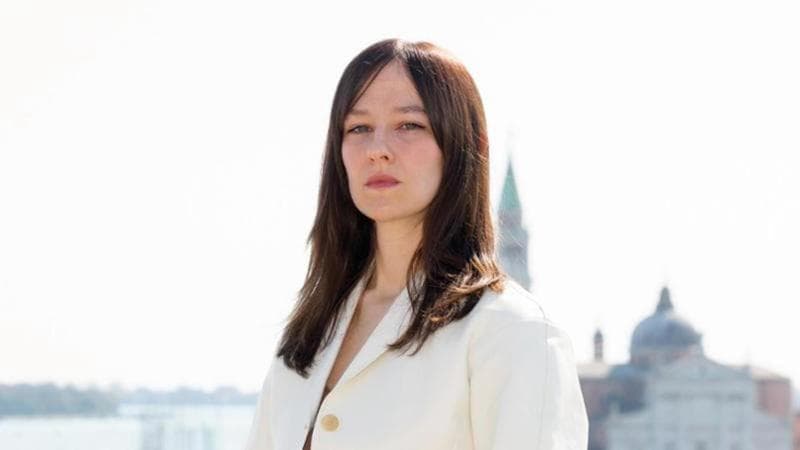
There is a point at which the millimetre precision of machines ceases to be mere calculation and becomes ecstasy. That is where Caterina Barbieri operates. Born in Bologna and now based in Berlin, the composer and guitarist has turned modular synthesisers into devices for introducing psychoacoustic trance with albums such as Patterns of Consciousness and Ecstatic Computation.
As artistic director of the Venice Music Biennale, she has challenged the institution's conventions, taking music beyond traditional concert halls into unexpected spaces and programming artists who defy classification, from Golden Lion winner Keiji Haino to Silver Lion recipient Sarah Davachi.
The latest edition, entitled A Child of Sound, challenged passive listening and sought to rediscover the liberating power of the avant-garde. The 70th International Festival of Contemporary Music, which closed on Sunday 25 October, recorded a 4% rise in attendance, with international visitors accounting for 40% of the audience.
For Barbieri, the Child of sound is a symbol of both revolution and healing, embodying music's power to bring people together and inspire spiritual transcendence. That vision took many forms, some of them extraordinary: the shamanic performance of Golden Lion winner Keiji Haino, the handmade balloons of Brazil's baloeiros, and Laraaji's lessons in "sacred laughter".
This was your second year directing the Venice Music Biennale. What did you learn from the previous edition about your relationship with musicians and audiences?
"The experience taught me a great deal, particularly through the outdoor concerts and participatory formats, such as the procession of small boats that opened the festival. It was about the idea of a shared journey that goes beyond the traditional concert experience, bringing different audiences together and attracting people of all generations.
"This year, I wanted to open the festival up even more to Venice. We staged events in unusual locations, including the pine grove on Sant'Elena, with a new commission for electric guitars by Gigi Masin and another for M.L. Buch, as well as the sunset opening at the Arsenale, featuring Laraaji alongside the ritual of the Brazilian baloeiros.
"All of this was inseparable from the theme A Child of Sound: the idea of childhood as a state of listening, containing an irreverent energy capable of breaking rules in order to create new ones."
You mentioned exploring new spaces.
"Exactly. This year, I wanted to continue along that path, partly to make the festival even more accessible to people in Venice, where attending concerts can sometimes be a major problem.
"As you know, ensuring that everyone can attend is not easy, partly because venues have limited capacity and partly because of the many bureaucratic and safety requirements that have to be met.
"My intention was to open things up as much as possible, because I believe a festival like this should be accessible to the widest possible audience.
"For example, we organised an event in a public park specifically to establish a more direct connection with the city. It was a new commission for Gigi Masin, a Venetian composer who very rarely performs in his hometown, written for an expanded ensemble of electric guitars.
"The concert took place in the pine grove on Sant'Elena, an area of Venice near the Arsenale. It's a wonderful place. I used to go walking and running there in the mornings, and I noticed a rather abandoned-looking skating rink in the middle of this forest of maritime pines, the only wooded area in Venice. I immediately imagined a concert taking place there.
"Another very important outdoor event was the opening concert by Laraaji, a legendary figure in ambient music who has always remained outside the commercial music scene, even though Brian Eno produced and supported him early in his career [on Ambient 3: Day of Radiance, the third instalment of Eno's ambient series].
"That was followed by a performance involving the baloeiros, a largely illegal subculture in Brazil centred on the tradition of releasing handmade hot-air balloons into the skies above Rio de Janeiro, São Paulo and other cities.
"In Brazil, the practice is seen as a genuine act of resistance and is often accompanied by music. These ceremonies carry enormous emotional significance, and I was fascinated by the idea of opening the festival with a collective moment centred on inflating and releasing one of these balloons.
"It felt entirely in keeping with the atmosphere and theme of this year's festival, A Child of Sound: the idea of childhood as a state of listening, with its irreverent energy, the child who breaks the rules and creates new ones, reconnecting with the revolutionary force that avant-garde music should never lose."
Turning to the rediscovery of Italy's electronic music heritage, you chose to bring Francesco Messina's Prati bagnati del monte analogo back to the stage — a real hidden gem.
"I'm a huge admirer of that album. I wanted to honour the tradition of the Italian electronic avant-garde, which is often celebrated abroad but rarely performed in Italy.
"For the Biennale, Messina presented a reworked version of the album alongside previously unheard pieces from a new project entitled Le api dell'invisibile.
"He enthusiastically accepted the invitation precisely because he is still composing and was delighted to have the opportunity to present new music."
The figure of the child recurs throughout your curatorial manifesto, as you mentioned earlier, and you also quote Karlheinz Stockhausen. How does childhood connect with the avant-garde?
"Stockhausen saw the child as the ideal model for the artist and childhood as the original source of listening, the aspiration to experience sound with unconditioned ears.
"Electronic music has possessed that same energy from the very beginning: the ability to construct abstract universes in which the immediate connection between physical gesture and sound production disappears.
"When you hear a violin, established historical associations immediately come into play. In electronic music, by contrast, the physical density of sound takes precedence, disarming and overwhelming you on a bodily level."
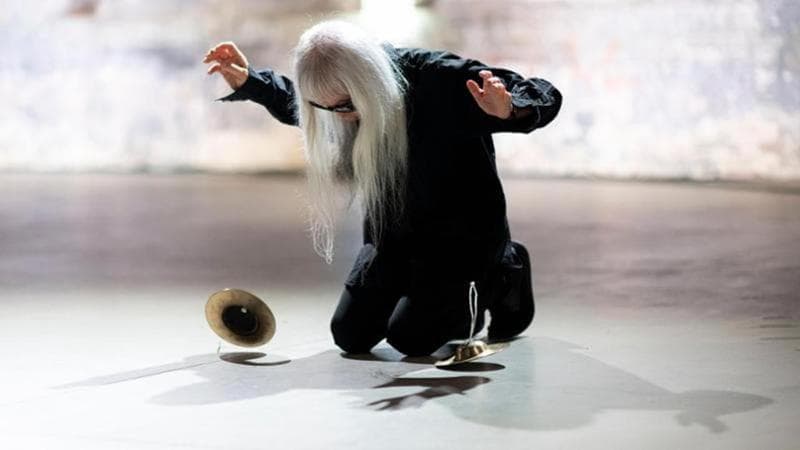
Awarding the Golden Lion to Keiji Haino was a bold decision. His award ceremony was practically another performance in itself.
"For an institution, engaging with him was a salutary experience.
"Cultural institutions often try to explain art in order to make it more digestible, at the risk of distorting its very nature.
"Haino refuses any compromise. He even declined to provide a descriptive text when we asked him for one.
"He repeatedly says that sound has a life, a force and rules of its own, and that the artist's role is simply to follow them. It's an Eastern approach, far removed from the Western emphasis on rational control.
"In fact, during his solo performance, he did virtually nothing he had announced in the programme note we had asked him to provide. He was supposed to play the hurdy-gurdy, but instead played the polygonola, an instrument created by a friend of his [a biologist who developed its sounds from the noises made by striking watermelons].
"Alongside the concert, we also presented, for the first time outside Japan, Kazuhiro Shirao's documentary about his life, tracing his journey from childhood drawings to his system of graphic notation, as well as a previously unseen audiovisual installation by Invernomuto."
The Silver Lion, meanwhile, went to Sarah Davachi. Why did you choose her?
"Sarah Davachi is a pioneering figure who has managed to combine the acoustic exploration of historic organs with electronic synthesis.
"Her music is deeply contemplative, built around extended durations and subtle variations in timbre. In a frantic, consumer-driven age, she makes time stand still.
"At the Teatro Goldoni, she presented a new work with the Parco della Musica Contemporanea Ensemble, conducted by Tonino Battista, in an evening that also featured the premiere of Ennio Morricone's Musica per una fine, a work incorporating a recording of Pier Paolo Pasolini reciting his poem Gli italiani, alongside music by Bach and Webern.
"She then gave a solo concert at the Teatro dell'Arsenale, offering the audience the opportunity to experience that unique sensation I was describing."
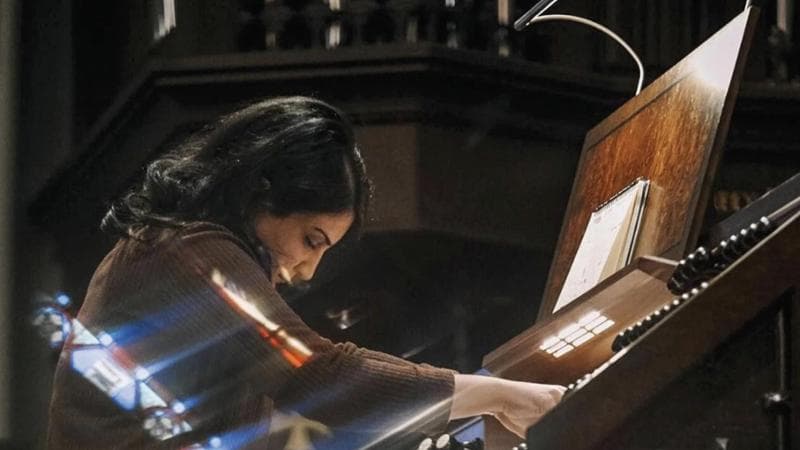
Sarah Davachi
Another moment of profound spiritual intensity came when the festival reached the very heart of Venice, St Mark's Basilica, with music by Hildegard von Bingen alongside works by other composers, some of them contemporary.
"Being able to enter St Mark's was an extraordinary achievement, made possible by the Patriarch of Venice.
"With The Tallis Scholars, we created a musical arc spanning the centuries, connecting the medieval melodies of Hildegard von Bingen with the Roman polyphony of Gregorio Allegri, the sacred minimalism of Arvo Pärt and a new commission for Kara-Lis Coverdale.
"Encouraging established ensembles and contemporary women composers to move beyond their comfort zones in such a monumental place of worship is precisely what the festival is about.
"We also forged a connection with the Holy See's pavilion, curated by Cardinal José Tolentino de Mendonça, who wrote a masterful essay on listening. It was one of the aspects most appreciated by visitors."
The programme also featured ancient ritual practices, such as Cuban Santería reinterpreted by Walter Zanetti.
"We operate at the intersection of ancestral roots and the present.
"We invited Asmâa Hamzaoui and Bnat Timbouktou, an all-female group working within the Gnawa tradition, but unfortunately they ultimately had to withdraw because of visa problems.
"And Walter Zanetti created a magnificent work with Cantos Yoruba de Cuba, transposing the polyrhythms of batá drums and the sacred chants of Santería onto the classical guitar.
"We're interested in showing how ancient forms and collective trance can be revitalised through contemporary experimentation."
How has your relationship developed with Biennale president Pietrangelo Buttafuoco, who has found himself at the centre of heated controversy?
"There has always been mutual respect and complete trust between us.
"He has embraced every one of my artistic proposals and has also contributed ideas of his own, such as Musica libera, probably the most moving project of all.
"It involved two performances at the Giudecca women's prison and grew out of the history of prisoners' songs in Palermo.
"We created a workshop with young artists from Biennale College and mentors including Moor Mother, Lyra Pramuk and Simone Trabucchi, composing music together with the women inmates.
"Everyone who witnessed it was deeply moved.
"As for the controversies, we live in an age marked by polarisation and the temptation to censor.
"The Biennale must remain a sanctuary for artistic freedom. Censorship is never a cultural instrument."
Finally, your choices have given women a prominent role in experimental music, something that is deeply rooted in the history of electronic music itself. The documentary Sisters with Transistors made it clear that electronic music was shaped by extraordinary female pioneers — from Delia Derbyshire and Éliane Radigue to Pauline Oliveros and Suzanne Ciani, who appeared at last year's Biennale. These women found in electronic machines a space of complete freedom, beyond the constraints of traditional academic institutions. Now that a woman is directing the Music Biennale and awarding the Silver Lion to Sarah Davachi, how important is that history to your vision of the festival?
"It's simply a natural recognition of reality.
"From pioneering figures such as Meredith Monk, who received the Golden Lion last year, to Sarah Davachi, whom we've just discussed, and artists such as Marta De Pascalis, Grand River and Joy Guidry, we're talking about women who are among the defining figures of today's avant-garde.
"It would be easy to fall back on safe choices or artists already celebrated by the mainstream.
"But the primary duty of a public institution is to give a voice to radical artistic visions that would struggle to find a platform elsewhere.
"If we don't do it, who else will?"
And now that your tenure has come to an end, what do you plan to do next?
"Now I need silence to find my way back to my own music."
This article was reviewed by an external translation partner