
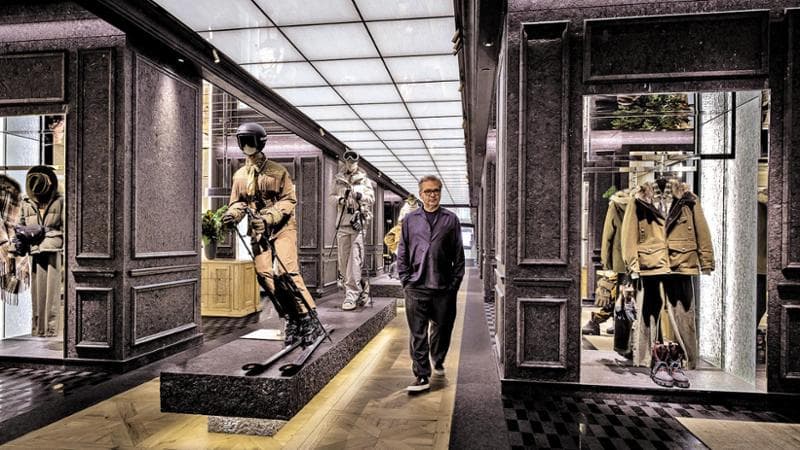
MILAN – Two thousand two hundred square metres on Fifth Avenue, just steps from Central Park. This is where Moncler’s latest New York venture begins, in the former home of the legendary FAO Schwarz toy store. It is also the brand’s most ambitious project yet: its largest store anywhere in the world. A major investment — the company is keeping the figures firmly under wraps — and a considerable gamble, as chairman and CEO Remo Ruffini acknowledges. “A risk, certainly. But a necessary one.”
Why do you describe opening a store on Fifth Avenue as a risk?
“Investments on this scale inevitably involve risk. We’ve been working on the project for three years, and in that time both the economic climate and consumer shopping habits have changed considerably. Our priority remains expanding in the American market, which is still the centre of the luxury industry. We have a strong position here: the United States accounts for 14.5% of our revenue. Compared with other brands, where the figure is 20% or 22%, we still have some catching up to do, but we’re doing well.”(Revenue in the Americas rose by 6% in the first six months of the year compared with the same period in 2025.)
How have shopping habits changed?
“In America, the focus is increasingly on high-spending customers who buy 15 or 20 pieces at a time. With them in mind, we’ve included several private shopping suites, as well as a bar, to offer greater privacy. There are fewer aspirational consumers — people who buy into a brand because of its status. It’s no coincidence that you see far fewer logos around these days. There was a time when young people in Milan would queue up on Saturdays to buy a branded cap. That simply doesn’t happen anymore. People are looking for a more complete experience, and we can’t afford to ignore what these changes are telling us.”
What does it take to succeed today?
“You have to keep changing, just as the market does. It’s part of the game. Over the past two years, for example, hiking and outdoor pursuits have been doing extremely well. So I’ve put more emphasis on Grenoble, our sportswear collection, while scaling back Genius, which features collaborations with various designers and is more focused on fashion itself.
Before that, I discontinued the runway shows for Gamme Rouge and Gamme Bleu, which used to be our high-end fashion lines, because I realised that such a traditional format didn’t entirely reflect who we are, even though both collections were doing extremely well. I felt we needed to change, and Genius eventually grew out of that decision.”
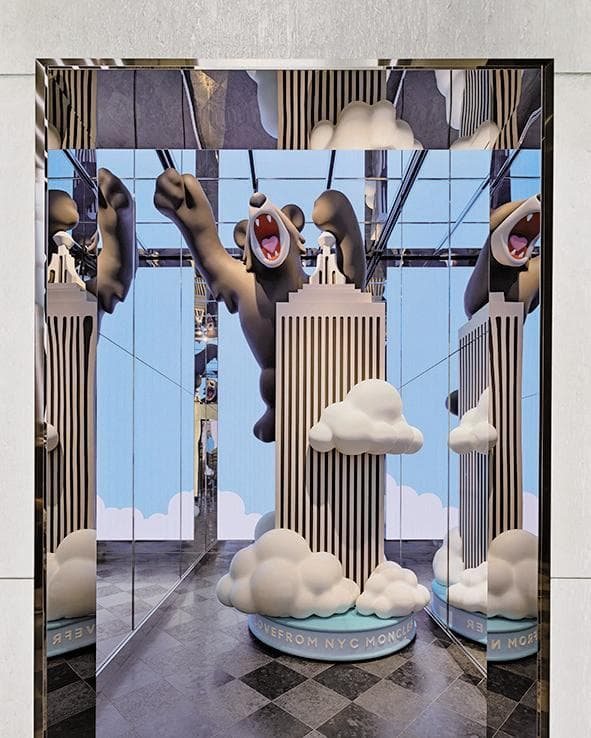
The store occupies a legendary address. How did you come to choose it?
“In a way, I grew up at FAO Schwarz. My father lived in New York, on 77th Street, and whenever my brother and I came to visit, if he didn’t know what to do with us, he’d bring us here and let us spend hours playing with the toys on display.
Years later, I was walking past with a friend when he told me the store was about to close. That planted a seed. I had already decided that we needed a place in the city where we could properly showcase everything we do, and I realised this might be exactly the right location.
We took over the premises, and then the long, complicated renovation began. The place was a maze of little rooms. We tore everything out to create a space spread over several levels, making sure that, from the moment you walk in, the entire Moncler universe, in all its different forms, is on display.”
What did you want to achieve with the interiors?
"I try never to look at what everyone else is doing. I don’t like following trends. I asked Gilles & Boissier, the design studio we work with, to create a space that would be easy to navigate, warm and welcoming. But let’s be clear: first and foremost, this is a place to sell clothes. That remains the priority.
Many brands are adapting the weight and materials of their clothes to warmer temperatures. Is Moncler, a brand originally created for cold weather, doing the same?
“We design clothes for enjoying the mountains all year round, so in terms of the products themselves, not a great deal has changed. What has changed is the timing. We used to start selling our heavier jackets in June; now we start in October.
What we call the transitional season has become longer, so we’re placing greater emphasis on lighter pieces for early winter, as well as our summer collections. It’s more a question of reorganising than starting again from scratch”.
The translation of this article was reviewed by a Language Service Provider