
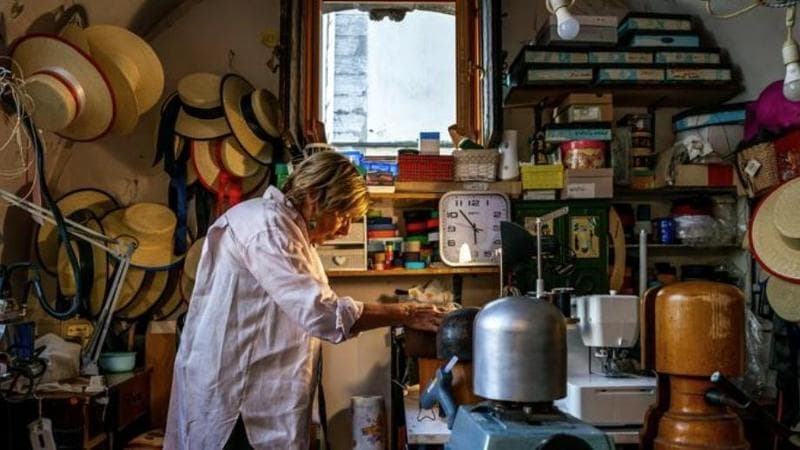
VENICE – In a Venice awash with trinkets and fakes, there are still craftspeople keeping time-honoured traditions alive. Giuliana Longo is one of them. She runs a historic millinery workshop on Calle del Lovo, in the San Marco district, where hats have been made by hand since 1901 — for women, for men, and for gondoliers. “The workshop has been here since 1901, a year before the old bell tower of St Mark’s collapsed,” Giuliana says.
She is the latest in a long line of Venetian bareteri, or hatmakers. “My mother, grandmother and great-grandmother were all milliners, and I learnt the craft from them, right here in the workshop.” There is, she points out, an important distinction: “Let’s not forget that a milliner makes women’s hats, while a hatter makes men’s.”
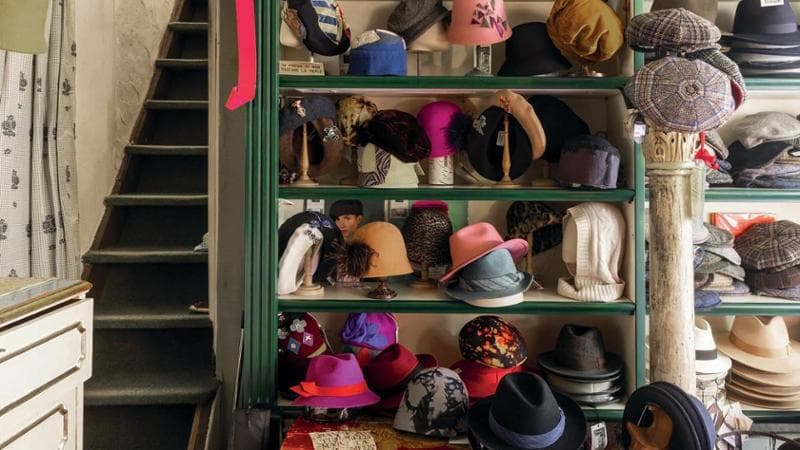
The workshop also makes the traditional hats worn by gondoliers. In summer, they are made from woven straw and finished with two satin bands matching the parecio, the traditional term for the gondola’s interior furnishings. In winter, they are made from black felt and finished with a bow.
Last year, Longo created a white linen beret embellished with a leone in mòeca — the Lion of St Mark depicted front-on, with its wings spread. The design recalls the claws of the small crabs found in the Venetian Lagoon and was crafted by a Venetian metal artist.
Her Panama hats are also in great demand. “They’re made entirely by hand in Ecuador, especially for us. It was my idea,” she says. They are, of course, perfect for the Venetian sunshine. Giuliana has travelled extensively in search of the right craftspeople to collaborate with.
The Panama hat, after all, has its roots there, not in Panama, which for centuries was the main trading hub from which the hats were shipped overseas, hence the name. It is traditionally made from fibres extracted from the leaves of the toquilla palm (Carludovica palmata) and was originally produced mainly in the town of Jipijapa, as well as in Cuenca and Montecristi, Ecuador. These are the kinds of stories you discover in a workshop like this, the kind of place that has become increasingly rare. But then, this is Venice — a city that has always been a port and a crossroads where worlds meet.
The translation of this article was reviewed by a Language Service Provider