
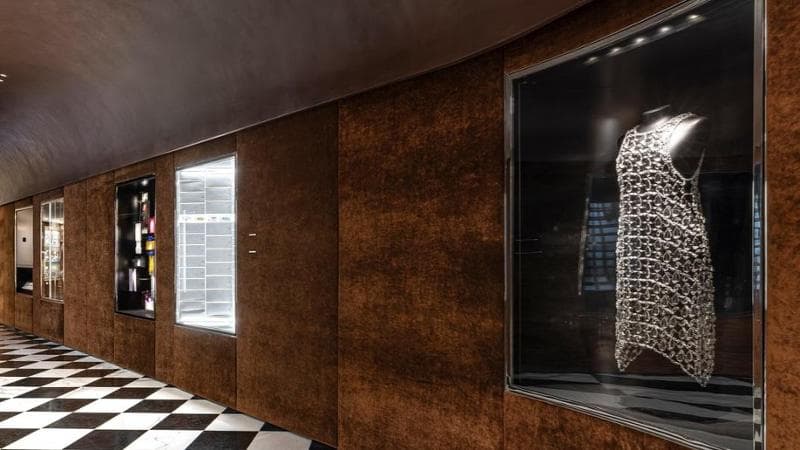
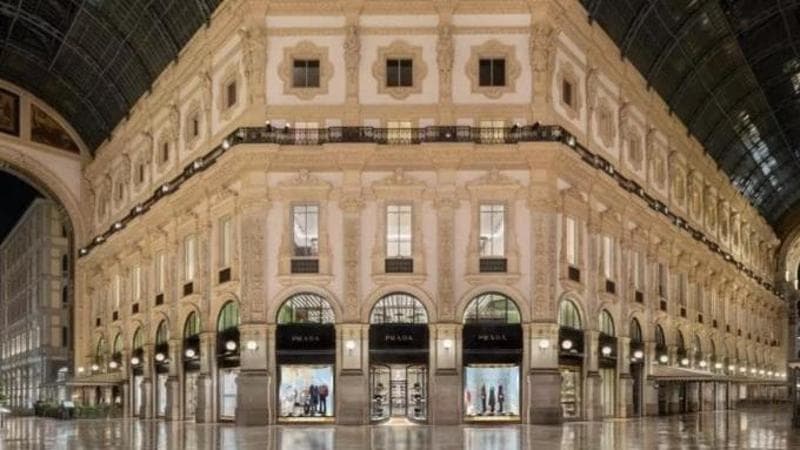
MILAN – Beneath the feet of the tourists crowding Milan’s Galleria Vittorio Emanuele, Prada has built a secret passage. The underground tunnel connects the company’s first store, opened by the Prada brothers in 1913, to the building on the opposite side of the octagonal square under the dome. Through architecture, past and present are physically reunited with a precise purpose: to tell the story of one of the world’s most famous Italian brands.
“I want to be modern”
“I want to be modern,” Miuccia Prada stated in 2004, “so I reject nostalgia, even though I am not immune to it. But contradictions are what make the work so contemporary, because today we are all made up of opposites.”
The words appear prominently in one of the rooms of Pradasphere, a space somewhere between a museum, an archive and an immersive experience, and the culmination of a journey that began with previous travelling editions in London and Hong Kong in 2014 and Shanghai in 2023.
Where it all began
The space stretches across the piano nobile of the same building that houses the historic Marchesi 1824 café, the Fondazione Prada Osservatorio, which opened in 2016, and the Prada Uomo store. As you walk among display cases and installations, the sign of that original shop where it all began occasionally comes into view through the windows.
Before Miuccia took over the family business, Fratelli Prada focused on suitcases, hatboxes, bags and finely crafted objects. Her grandfather, Mario Prada, drew inspiration from his travels around the world, seeking to offer his customers a touch of the extraordinary amid the ordinariness of everyday life.
The unmistakable logo
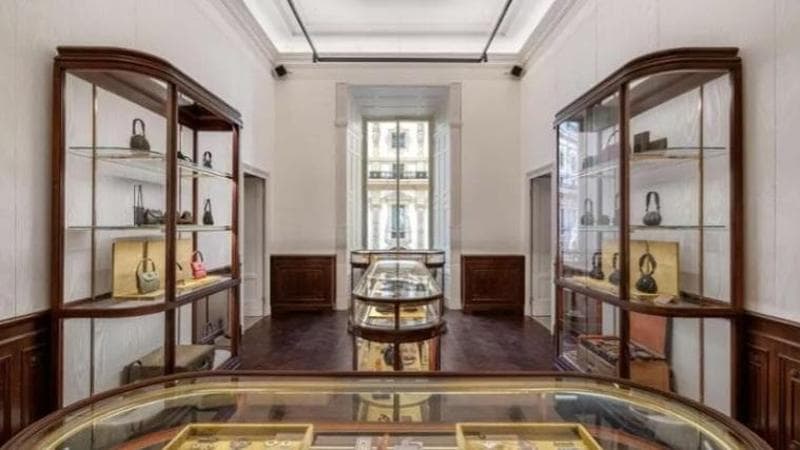
Some of the objects so cherished by Milanese customers at the beginning of the 20th century are now on display for the first time: natural-bristle brushes, small mirrors, Art Deco bottles, and cases crafted from ivory, amber and precious silks.
Among them is the tissue paper once used to wrap the products, bearing the unmistakable logo that, from 1919, was allowed to incorporate the royal coat of arms of the House of Savoy, signifying that the company had been appointed an official supplier to the kings of Italy. The evolution of that same logo can be traced on metal plaques, already taking on the triangular shape that has survived to the present day.
The arrival of nylon
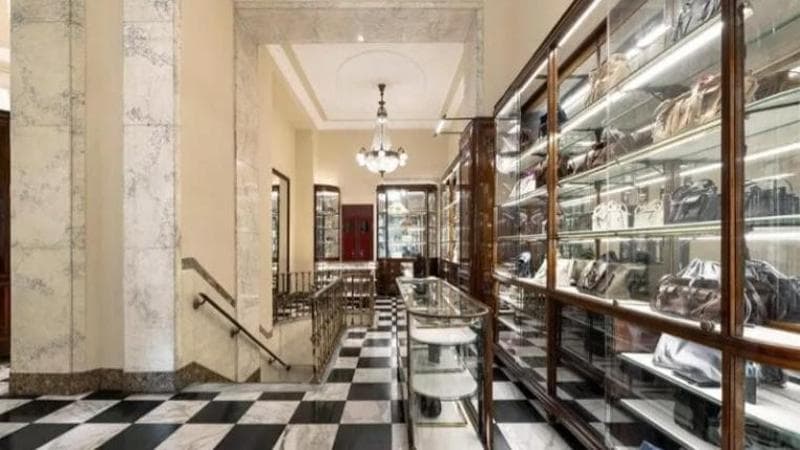
After the first few rooms, the sight of the Camera Bag and nylon backpacks has a powerful visual impact, sharply contrasting both with the antique feel of the display cases and with the objects that have come before.
The use of nylon marks Miuccia Prada’s revolutionary arrival in the family business. The technical fabric, previously used to line bags and suitcases, was now brought to the outside, giving the objects a minimalist character that anticipated, well ahead of its time, the aesthetic that would come to define the 1990s.
A statement of intent
Looking back, the temptation to see the Camera Bag and the backpacks as symbols is hard to resist. Every detail seems to amount to a statement of intent: a quest for the new, a reinvention of the past and a break with traditional conventions.
In 1988, that aesthetic turning point was captured in the photography book Prada Milano. Today, Albert Watson’s black-and-white photographs hang on the walls of the third room of Pradasphere. In one of them, Miuccia Prada appears with her customary discretion, wrapped in a pale coat, half in profile, her gaze turned away from the camera.
This photograph, too, tells more than can immediately be seen, almost formally marking the definitive transition. It was during those years that Miuccia Prada and her husband, Patrizio Bertelli, took control of the brand and opened it up to the world, without ever severing its deep Milanese roots.
Milan is where the journey begins, and where it repeatedly returns in the first rooms of the exhibition: from the herringbone parquet beneath visitors’ feet to the moiré silk covering the walls, reminiscent of an old apartment belonging to the city’s bourgeoisie.
Then comes the green — a sage green chosen by Miuccia Prada from hundreds of shades to represent the brand and now a defining feature of Prada stores around the world. The sage-green room is smaller than the others, but perhaps more than any other it concentrates the intense energy of a time capsule. On its walls are some of the designer’s best-known statements over the years.
“When you start falling in love with what you do, then you’re in danger.”
And: “You always have to work against what you’ve already done, often even against your own taste.”
The philosophy of the brand
The brand’s philosophy is clear, and it also emerges from the first look from Prada’s first ready-to-wear show, staged in Milan in 1988 and now preserved almost like a relic. It is a sweeping brown coat that rejects ostentation and already anticipates the idea of a new kind of woman, an aesthetic now described as “ugly chic”: a rejection of the stereotypes of hyper-femininity.
But another important word dominates the room: “evolution”. It reflects Prada’s interest in new cultural fields beyond fashion, from sport and cinema to contemporary art and architecture.
In Pradasphere, the story of that transformation is entrusted to the objects that have shaped it: from an early 20th-century bag decorated with a satyr to a model of Luna Rossa and the technical-fabric spacesuit created by the fashion house for Axiom Space ahead of NASA’s Artemis mission scheduled for 2028.
The immersive experience becomes complete when technology itself becomes an integral part of the journey. In one room, visitors can sit in an armchair with a built-in digital screen and browse videos of Prada’s most celebrated campaigns and fashion shows one by one. In a small vintage-style cinema, meanwhile, short films and movies made in collaboration with artists including Wes Anderson, a longtime friend of the brand, and Ridley Scott are screened continuously.
The library, an essential element
“How do you build a career in fashion?” a 10-year-old girl asked Miuccia Prada during a talk in 2020.
“Study! Study! Study!” the designer replied.
The line went viral and perfectly sums up the importance Miuccia Prada places on education. That is why the library is an essential part of Pradasphere.
Here, among orderly wooden desks reminiscent of mid-20th-century academic interiors, art and fashion students will be able to come and study and consult books ranging from contemporary art and architecture to photography. This is where the space becomes participatory and shared, a hub for the circulation of ideas as much as for quiet reflection.
On the upper floors of the building are two more distinctly exclusive areas: a studio for client appointments and fittings, and an apartment intended for private events, its interiors meticulously curated.
The style evokes an 18th-century home, with a large dining room, a kitchen and several sitting rooms where antiques and contemporary artworks selected by Miuccia Prada blend together, entering into dialogue with the mosaics of the Galleria visible through the large windows.
On the walls are works by Andreas Gursky, the German photographer whose work explores the idea of an encyclopaedia of life. Known for his XL-format photographs, he was also featured in Typologien, the 2025 group exhibition at Fondazione Prada in Milan.
The secret passage
The entrance to the famous secret passage is reached by descending to the building’s basement level.
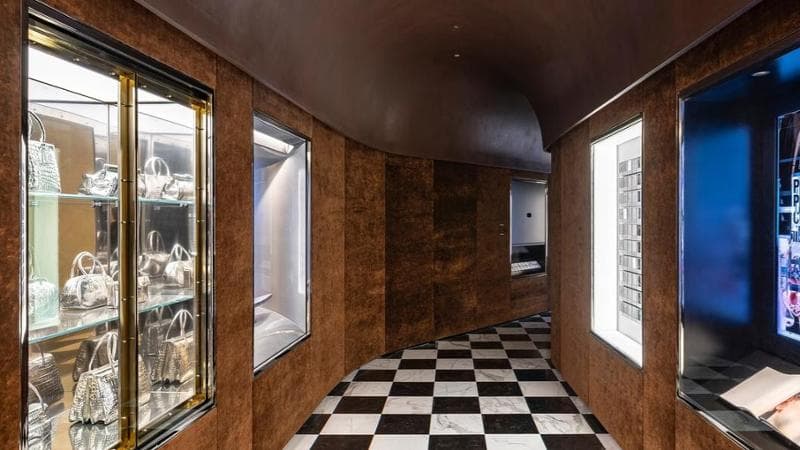
It is called a secret passage because it is an underground tunnel running beneath the bustle of the Galleria, hidden from view until recently. Today, it connects the men’s and women’s stores.
But the tunnel is more than a place of transition and connection. It becomes a narrative space in its own right, with illuminated display cases recounting lesser-known episodes from the brand’s history, including its early experiments in cosmetics and pioneering ventures into technology, such as its collaboration with LG on the Prada Phone in 2011.
From underground, visitors emerge into the Prada women’s store, which has been expanded beyond the original space with a basement floor that has almost doubled the display area. Dedicated sections focus on travel, home and beauty, surrounded by historic murals and archive pieces.
The journey through Prada Galleria ends where it began, in the original Fratelli Prada store, whose suitcases and precious objects now form only the first chapter of a much longer story.
At the end of the journey, the sensation is of stepping out of a time machine that is still moving towards the future.
Then comes a kind of vertigo: having started in Milan, you suddenly find yourself caught up in the threads of a collective history with which the brand has been in constant dialogue, until it became an integral part of it.
Prada Galleria opens your eyes to a revolutionary way of looking at tradition, freeing it from stasis and questioning it through the language of the present. It becomes clear, then, that none of this is really about a museum, or about nostalgia. It is only the beginning of a new way of telling the story of our time.
The translation of this article was reviewed by a Language Service Provider