
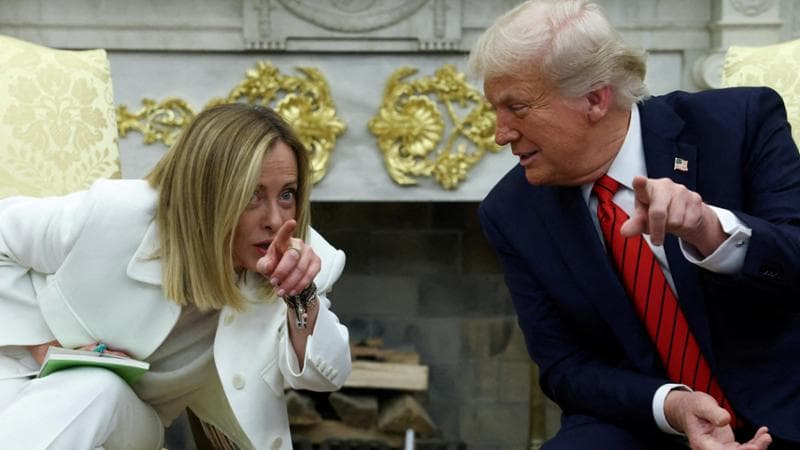
ROME – Trump who? At Palazzo Chigi, the seat of the Italian government, the time has come for decisive choices. Not about relations with the United States, of course: that relationship remains indispensable, if only because of the American military shield. That is the message being published by Meloni propaganda outlets in Parliament as news of the "Democratic tsunami" arrives from across the Atlantic. It is also the line unofficially attributed to the prime minister herself: Italy does not interfere in other countries' domestic politics, nothing has changed between the two nations, and the United States remains a vital ally, regardless of which party or government is in power.
The reality, however, is starkly different: the midterm elections have made the personal break with the tycoon irreparable.
It is a matter of political positioning and survival. Whether that will be enough remains to be seen.
A secret flight to Tehran
The breakdown of trust between Giorgia Meloni and the White House can be traced through two very different clues: an aircraft and a Fox News broadcast. First, the plane. At 2.10am on 3 November, just hours before polling stations opened in the United States, a private jet took off from Rome's Ciampino airport bound for Tehran. It landed in the Iranian capital and remained on the ground for eight hours. Its identification code masked the aircraft’s identity, according to specialist flight-tracking websites, as often happens with CAI flights, the airline used by Italy's intelligence services.
And indeed, this was an Italian intelligence mission.
Far from being a minor detail, the flight offers another strong indication of the parallel diplomacy Rome continues to pursue with Tehran — contacts that never ceased, even during last spring's bombing campaign.
Since the conflict began, Italy's objective has been to avoid exposing itself to danger or becoming a potential target. Economic and commercial interests, shipping through the Strait of Hormuz and domestic security are all at stake.
That approach is unlikely to change in the new global landscape heralded by the Democrats' blue wave in the United States.
Trump's swipe at Italy and France
The second clue comes from the other side of the Atlantic.
In the early hours of 4 November, Italian time, a defeated and unpredictable Trump phoned Fox News. He began by talking about the border with Mexico: "It was like a sieve, and we sealed it in two months. For 17 months, nobody has been getting through from the south into the United States."
Then, seemingly without any particular reason, the president turned his attention to Rome.
"Europe is dying. France and Italy are in terrible shape. These countries might not even survive."
It was an unprovoked slap in the face for his former friend Meloni, delivered without the slightest consideration.
Ukraine forces Meloni to choose sides
Embarrassment, silence and decisions whose timing speaks volumes.
Take the new package of military aid for Ukraine, which Palazzo Chigi has kept on hold for months. On 10 November, Defence Minister Guido Crosetto will present it to Copasir, Italy's parliamentary intelligence oversight committee.
The timing of the announcement is revealing. With the midterms over, Meloni must decide whether to stand alongside Europe in supporting Kyiv or pull back. Inevitably, she has chosen to side with Europe.
Aligning herself with Europe's major capitals also means keeping diplomatic channels open with Paris, London and Berlin, even though the E3 countries pursue their own agendas and exclude the Italian prime minister from some discussions.
Rome is nevertheless maintaining a dialogue with them to assess how best to respond to Trump's erratic reactions. There are also discussions about possible responses that would demonstrate strategic autonomy, now that the US administration has been brought to its knees.
How would European leaders react if Trump invited Vladimir Putin to the G20 summit in Miami in mid-December?
The option of threatening to boycott the summit or sending lower-level delegations is back on the table. Here, too, Meloni will side with the European Union.
Iran, the deepest divide with Washington
Then there is Iran: the issue on which, according to the thinking now prevailing at Palazzo Chigi, Trump has destroyed his presidency. It is also the issue that threatens to further destabilise the international balance of power, to Europe's detriment.
For this reason, the Italian government has no intention of endorsing further attacks, having already broken with the US president over the use of Sigonella, the NATO air base in Sicily, during the first phase of the war.
This position was established some time ago and has therefore not been influenced by the threats issued by Iran in recent hours.
"If America uses its bases in Europe, including those in Italy and Germany, Iranian missiles will be launched towards Europe," Ahmad Bakhshayesh Ardestani, a member of the Iranian parliament's security committee, told Euronews.
This is the doctrine attributed last Saturday to Mojtaba Khamenei: a response to enemy threats "without geographical restrictions".
Against this backdrop, the parallel diplomatic channels and aircraft flying on secret missions become easier to understand.
So do the farewells: to the MAGA movement, to "Donald the dealer", to the red caps worn by Italian ministers.
As for how it will all end, nobody knows.