

CAMAIORE, LUCCA — One room is called the “stress room”. Another has a ping-pong table and a machine that fires balls at you. Then there is the “psychophysical room”, with four stations resembling video games. Finally, there is the “weight room”, equipped with eight giant screens. And that’s it. No barbells, no weights to lift. Just joysticks. And doctors, psychologists and fitness trainers.
Welcome to the “brain gym”, where Jannik Sinner trains to keep a clearer head at the decisive moments of his matches. Where he learns to “clear out his mind”, regaining the balance he needs to avoid mistakes on crucial shots. Where the right movement becomes automatic, unaffected by emotion.
A star-studded clientele, from Leclerc to Shiffrin
Sinner is far from alone. The gym attracts a host of other champions: skiers such as Federica Brignone and Mikaela Shiffrin, racing drivers Charles Leclerc and Fernando Alonso, Olympic medallists in fencing and swimming, and footballers from Italy’s Serie A, Germany’s Bundesliga and England’s Premier League.
Then there are business executives, astronauts, singers and pilots. Because the brain, it turns out, can be strengthened much like a bicep. And we could all do with a little of that. So we decided to spend a day at the gym ourselves.
One heartbeat at a time
Our destination is the headquarters of Formula Medicine in Capezzano Pianore, a village in the Tuscan municipality of Camaiore, near Lucca.
Formula Medicine is Riccardo Ceccarelli’s brainchild. He once dreamed of a career in Formula 1 and was a pretty good driver himself. But after graduating in medicine, he decided to pursue his passion for motor racing from the paddock, as a doctor rather than a driver.
Since 1989, he has worked with more than 1,800 racing drivers.
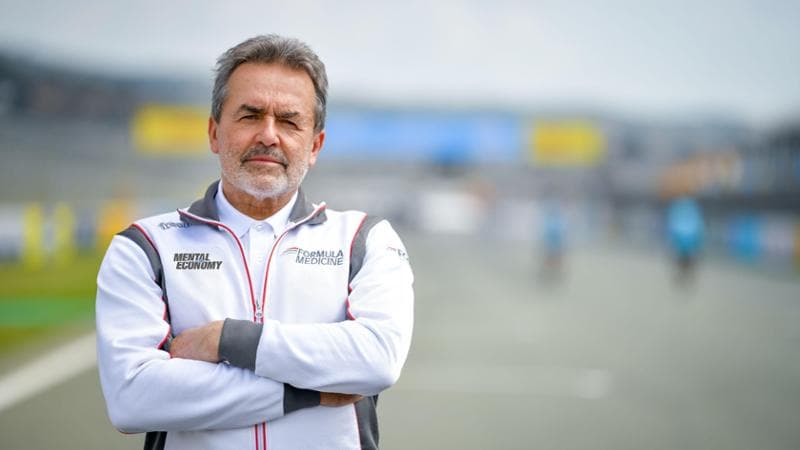
On the ground floor, a photograph shows him running along an Australian beach with three of them. The man on the left is Ayrton Senna.
“I carried out my first experiments on Ivan Capelli, who was my roommate during the national federation’s racing courses.” There were blood tests (“even on Ayrton”) before and after races, and heart-rate monitors. Ancient history now.
“These guys would maintain a heart rate of 190 beats per minute for an entire hour, with spikes on top of that. I started wondering: if they weren't making any additional physical effort behind the wheel, what muscle were they using, apart from their heart?”
The brain, of course.
The traffic-light experiment
In 2000, working with the neuroscience department at the University of Pisa, Ceccarelli completed a remarkable experiment. He compared the reaction times of professional racing drivers responding to a green light with those of “ordinary” people of the same age.
“They were practically identical: 192 milliseconds versus 193. According to the MRI scans, the key difference was mental fatigue. It was minimal among the drivers, who were accustomed to reacting almost reflexively and remained relaxed when they had to respond. Among the others, it was considerably greater.”
Putting mental stress to the test
We head upstairs. On display is a white tennis racket signed by Sinner, complete with a little heart.
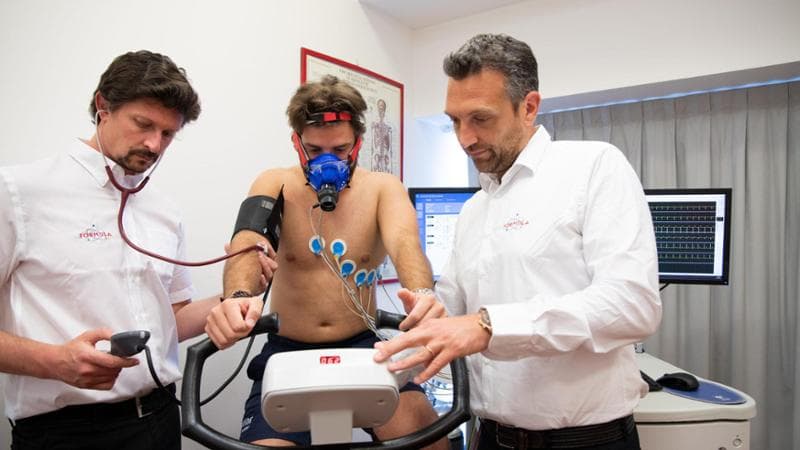
After a comprehensive medical check-up, we enter the stress room to find out how quickly my brain becomes fatigued.
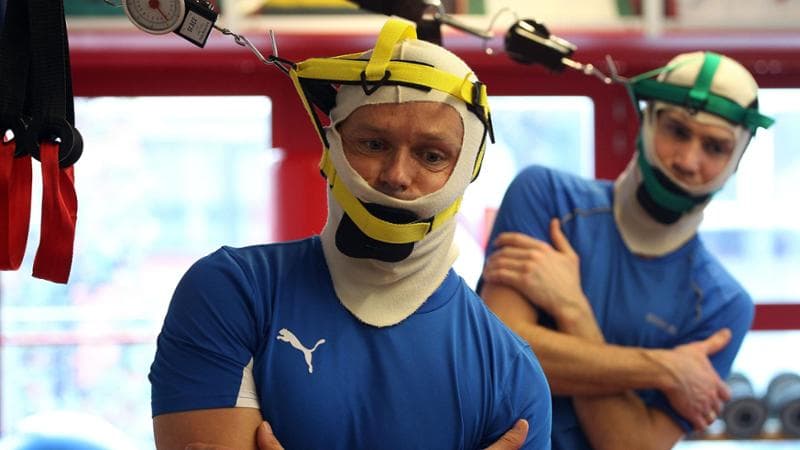
Words denoting colours appear on a screen, but the colours of the letters don't always match the words themselves. If the word “red” appears in red, I press “True”. If it appears in blue, I press “False”. One hundred times.
I have to respond within a set time limit.
At first, I'm tense and make a few mistakes. Then I find my concentration and everything becomes smoother. By the end, I'm exhausted and the mistakes start creeping back in.
Sensors attached to my body monitor changes in my brainwaves, breathing and heart rate. I can see it all plotted on a graph.
“Your readings are normal. With proper training, by clearing your brain of the factors that interfere with your performance, you could drastically reduce your mistakes. And respond more quickly,” Ceccarelli explains.
The ping-pong challenge
Next comes ping-pong.
The first ball arrives. I hit it. Then another. And another. The balls keep coming, faster and faster. I hunch over to keep up.
Everything is being monitored. I can see my heart rate climbing, along with the amount of energy my brain is using.
The doctor stops me and takes my place. He shows me that there's no need to hunch over or tense up.
“Why worry? What matters is the movement itself. Maximum performance with minimum effort.”
Follow the little car
Now we move on to the gym itself, where Ceccarelli works alongside psychologists and fitness trainers. There are four of us taking part in the first exercise.
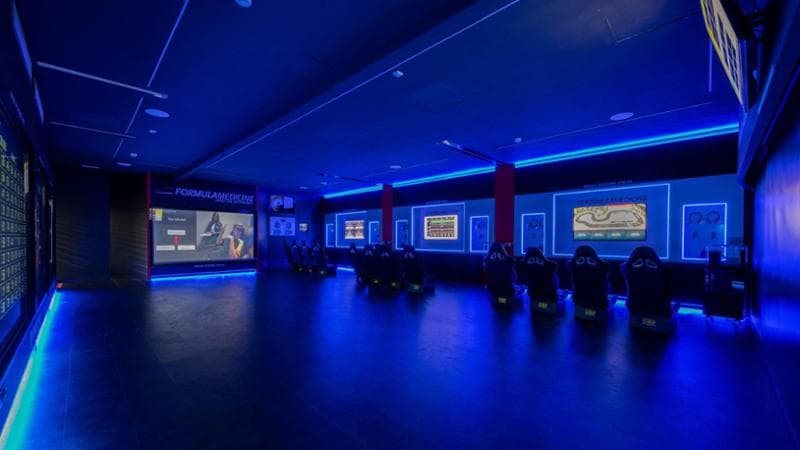
A racing circuit appears on the screen. To go fast, you have to keep your eyes focused on your own little car, which moves by itself, without being distracted by the numbers flashing up on the screen or by the other participants.
I win.
“Very good. Your heart rate and concentration remained steady, with very little emotional involvement.” Ceccarelli explains that this is an excellent way to “empty” the mind.
He shows me an old video of Sinner. During a changeover, the tennis player appears to be staring blankly into space.
“In his mind, he's watching his little car.”
Sinner's travel kit
Like other athletes, Sinner carries his own personalised training kit when he travels around the world: a computer program that reproduces these special mental exercises.
“It's particularly useful when they're feeling exhausted or there's a lot of commotion around them. It helps them regain control and a sense of calm.”
The mental arithmetic challenge
For me, the hardest exercise is “Calcolus”. A grid appears on the giant screen, filled with numbers from 1 to 100, scattered randomly across it. The task is to find them and touch them in ascending order, starting with 1. In the next stage, some of the numbers have to be added together and matched with colours.
“You were too competitive here and lost sight of the bigger picture. Try again. You need to keep the sympathetic nervous system, which kicks in when we perceive stress, under control as much as possible, while stimulating the vagal system, which promotes relaxation and control.”
Ceccarelli tells me that he hadn't even finished explaining the exercise when Jannik, whom he describes as naturally “functionally analytical”, had already solved it.

Brignone waited until he had finished, then solved it just as quickly.
Another famous skier dug her heels in, insisting that she was hopeless at maths. For half an hour, she couldn’t get anywhere with it.
“The secret is not to worry about having to solve a difficult test, but to look for the simplest way to do it.”
“Go down!”
Canadian skier Laurence St-Germain, another of Ceccarelli's pupils, provides a striking example.
At the 2023 World Championships, after the first run of the slalom, she fled back to her hotel, refusing to listen to her coach's advice.
She cleared her mind. And when it was time to head back out for the second run, she told herself just two words: “Go down!”
Just ski down the slope. Without thinking about anything else.
She won.
Before I leave, Ceccarelli offers one final piece of advice.
“Remember, the brain can be trained. Emotions and stressful situations can be managed. And in the long term, all of this translates into greater wellbeing.”
The translation of this article was reviewed by a Language Service Provider