Beyond his triumphs at La Scala, the great composer from Busseto was also a landowner who never forgot his humble origins and whose environmental awareness was ahead of his time. A new itinerary reveals this lesser-known side of the man behind Aida and La Traviata
7 min read
The other side of Giuseppe Verdi: a maestro with a passion for all things green. Farmer, countryman, cook and benefactor. Few people know that, beyond his magnificent operas – La Traviata, Aida, Rigoletto, Nabucco and Otello, masterpieces of the operatic repertoire – the celebrated composer from Busseto (10 October 1813 – 27 January 1901, with celebrations marking the 125th anniversary of his death still under way) was also a master of rural life, cultivating the land and frequenting farmers’ markets.
Even today, in the province of Parma, where the young Giuseppe grew up, visitors can discover remarkable places, recipes and surprising but true stories. Beyond the stages of theatres around the world, whose seasons have opened with performances of Verdi’s operas for 150 years, lies a fascinating and little-known landscape waiting to be explored.
We follow in his footsteps through his homeland, guided by Giampietro Comolli, president of the National Historical and Cultural Committee “Giuseppe Verdi, his era, his lands”. These welcoming places can now be visited along itineraries that reveal the countryside and buildings where the maestro lived.
Verdi was the son and grandson of innkeepers. On one of the first plots of land he purchased, he planted a large vineyard. At Sant’Agata, where he moved in 1850, wine and cheese were produced, and food was a means of expressing hospitality and enjoying convivial gatherings.
It was on such occasions that Verdi revealed himself to be unconventional, modern and innovative, respectful of the times in which he lived but also forward-looking and deeply sensitive to the needs of others.
The legacy of humble origins
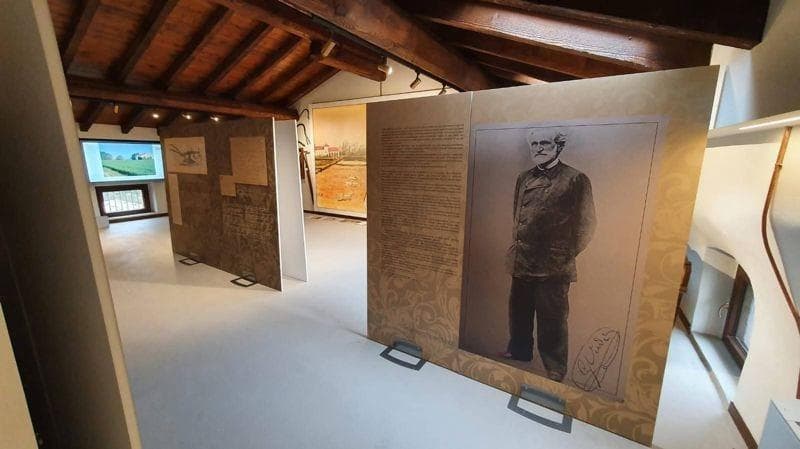
Inside the Agricultural Museum at Palazzo Costa Picasso in Soarza, which explores Giuseppe Verdi’s passion for farming
His humble origins ensured he never lost touch with those less fortunate than himself or those in need. His journeys through the countryside, from one farm to another, allowed him not only to see how his estates were faring but also to attend to the needs of his agricultural labourers.
He eventually owned 48 farmsteads, rural buildings and villas across three municipalities in the province of Piacenza and one in the province of Cremona, at Sommo. The properties extended over approximately 1,000 hectares, or 13,000 local units of land measurement known as pertiche piacentine, forming a single, vast estate.
In 1889, Verdi declared an income of 40,000 lire, making him the largest private taxpayer in the territory of the former Duchy of Parma and Piacenza.
Some 70 families worked on his land as farmers, dairy workers, tenants, agricultural settlers, sharecroppers, farmworkers and casual labourers.
“One might be tempted to believe, as he himself used to say, that his real profession was not that of a musician but of a farmer, or rather a farmer-artist, as Professor Fedeli used to call him,” says Comolli. Fedeli was the medical director of the Montecatini thermal baths, where Verdi spent several weeks every summer from 1884 onwards.
His decision in 1850 to settle permanently in Sant’Agata, rather than in Busseto or Milan, reflected a personal need to return to the countryside of Piacenza, the ancestral homeland of both his paternal and maternal families, the latter being the Uttinis.
As he himself explained: “I feel at ease in the middle of the flat countryside. I love those strange, immense silences, punctuated by natural sounds that relax me, help me concentrate, stimulate me and give me the rest I need after long journeys.”
He purchased a farmhouse with land in the hamlet of Sant’Agata, spending three years restoring, extending and modifying it. He made it his home with Giuseppina Strepponi and continued to live there until his death, welcoming friends, prominent figures, politicians and publishers.
Following in Verdi’s footsteps
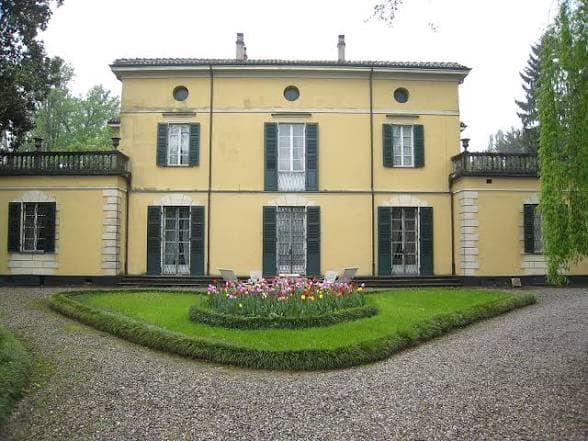
Villa Verdi in Sant’Agata, near Busseto, where the composer lived for much of his life and cultivated his passion for farming
For convenience, our journey with Giampietro begins at the railway station of the historic town of Fiorenzuola d’Arda, on the Via Emilia, 15 kilometres from Piacenza. It is one of the principal gateways to Verdi’s homeland.
Our first stop is the ducal town of Cortemaggiore, once known as Curte Major under the Carolingian counts of Charlemagne.
In the central square stands the Minor Basilica, whose last chapel houses a painting of the Virgin of the Angels. It inspired Verdi’s celebrated aria La Vergine degli Angeli from his opera La forza del destino.
It was also here that Verdi undertook his first philanthropic initiative, establishing a nursery school for poor children and providing it with a substantial financial endowment.
By car, motorbike or bicycle, visitors can continue to San Pietro in Cerro, where his grandmother and aunt were razdore, the local term for female cooks and household managers. They ran a licensed inn. Today, visitors can stop at the Locanda Re Guerriero.
The hospital and the old flour mill
In Villanova d’Arda, another of Verdi’s philanthropic achievements awaits discovery: the hospital he built and financed for the town’s poor. Currently undergoing renovation, it is set to become a Paralympic centre.
Near the town, on the road to Sant’Agata, a group of private individuals is restoring the historic Castellazzo mill, where Verdi had his grain milled and distributed flour to local farmers so they could bake their own bread.
Heading north towards the banks of the Po, on the outer edges of Verdi’s homeland, visitors reach the hamlet of Soarza. Here, the Pizzavacca-Pisaroni farm shop offers foods that were regular features on the maestro’s table at Villa Verdi.
They include seasonal pears, apples and cherries, shallots, onions and garlic, but above all giardiniera, a selection of pickled vegetables, and mostarda, a mustard-flavoured fruit preserve, served alongside his favourite meat dishes.
A short walk away, Palazzo Costa Picasso houses a traditional inn and a small museum displaying historical photographs that document rural life, agricultural implements and the farmhouses once owned by Verdi.
Extending the circular route further north brings visitors to San Giuliano di Castelvetro, along the same road Verdi travelled by horse-drawn carriage on his way to Cremona.
Here stand the ruins of the little Madonna delle Spine church and, nearby, the Church of Santo Spirito, where the young Verdi played the organ during Mass and stopped to pray.
The Lingiardi organ on which he played the Gloria at the Mass dedicated to Our Lady of the Rosary in October, around the time of his birthday, is still there.
The maestro’s passion for cheese
Following the left bank of the Ongina stream brings us to the Stallone dairy, where visitors can buy and sample fresh and aged cheeses.
It was on this very site that Verdi produced what was locally known as furmai piasentin, a hard, granular cheese made in large wheels and regarded as a precursor of today’s Grana Padano PDO.
As early as the 1880s and 1890s, the maestro sold his cheese through his estate managers at the weekly agricultural markets in Cremona and Piacenza, held on Wednesdays and Thursdays.
Less than a kilometre away, along the road following the banks of the Ongina, stands Villa Verdi and its park in Sant’Agata, within the municipality of Villanova d’Arda.
The property is currently undergoing extensive restoration, supported by the heritage authorities and the Ministry of Culture, which has allocated approximately €20 million to the project.
Villa Verdi and its remarkable gardens
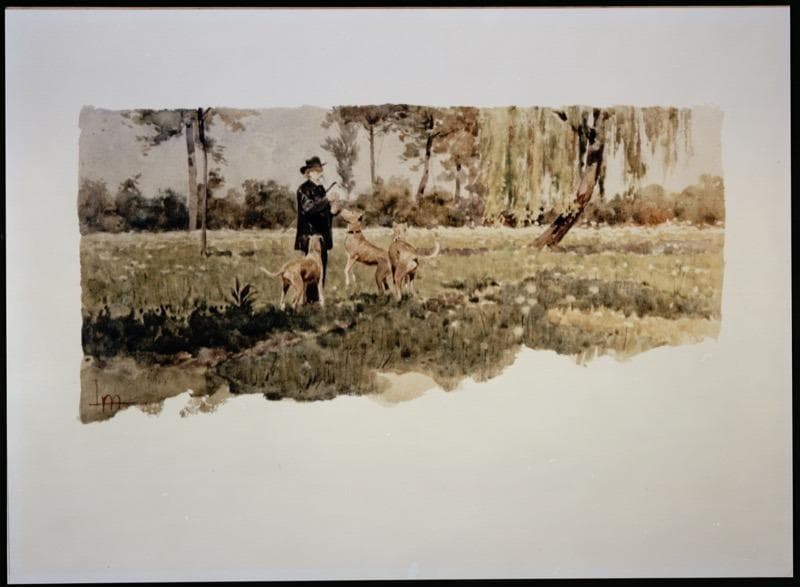
A painting of the composer in the countryside with his dogs
The villa’s combination of landscaped parkland, ornamental garden and vegetable garden is characteristic of a country estate of Verdi’s era, and was created according to the composer’s precise instructions.
As our guide Giampietro explains, the botanical selection combined native plants with striking exotic specimens – a balance that the restoration must preserve.
There were poplars typical of the Po Valley, oaks and black locust trees, apple trees and mulberries, the latter used for the fascinating practice of silkworm rearing. There were also palm trees and a banana plant, brought by rail to Fiorenzuola from a large nursery in Milan.
Nearby, at the traditional restaurant La Verdiana, visitors can sample a sandwich filled with coppa, the cured pork delicacy loved by the maestro.
On the opposite bank lies Busseto, home to the Verdi Museum at Villa Pallavicino, the Institute of Verdi Studies and Palazzo Barezzi, where the young composer practised on his father-in-law’s piano.
Not far away is Vidalenzo, where Verdi’s parents, Luisa Uttini and Carlo Verdi, are buried in the local cemetery. Their remains were transferred there from Saliceto di Cadeo and Roncole.
A cycling route through Verdi’s countryside
To complete the shorter circular route, particularly suitable for cyclists, and return to Fiorenzuola, visitors can follow the Ongina upstream towards Besenzone.
Here, an unforgettable Michelin-starred dinner awaits at La Fiaschetteria di Besenzone.
Another stop is the Peveri cured-meat shop, where visitors can discover Verdi’s beloved bondiola, known today as Coppa Piacentina PDO, rather than ossocollo.
The shop stands opposite an architectural and historical treasure: the Abbey of Chiaravalle della Colomba, founded by Saint Bernard of Clairvaux in 1136.
According to tradition, a highly prized cheese from the Lombardy-Piacenza area was produced here long ago, enjoyed by popes, kings, queens and emperors.
A journey following Verdi’s green footsteps might end with a chance encounter with Piero Carolfi at the Ronchi farm, just outside Fiorenzuola d’Arda.
A livestock farmer and veterinary surgeon in Verdi’s countryside, Carolfi is also the composer’s best-known living lookalike. He has portrayed the maestro in several documentaries, including Pupi Avati’s recent documentary film Le stanze di Verdi (Verdi’s Rooms), which explores the composer’s great passion for farming – perhaps even greater than his passion for music.
Along ancient pilgrimage routes to Piacenza
Those wishing to explore the longer itinerary, following the various Vie Romee, pilgrimage routes that crossed the region from north to south and east to west as early as the fourth century AD, can take the Via Emilia or the Via Postumia along the Po towards Piacenza.
Verdi served as a provincial councillor and, at Cavour’s urging, was elected to the first Parliament of the Kingdom of Italy in 1861, representing the constituency of Borgo San Donnino (now Fidenza). In 1874, he was appointed senator of the Kingdom. He frequently stayed in Piacenza from 1844 onwards.
For Verdi, Piacenza was not simply the location of the weekly Wednesday farmers’ market. Above all, it was where he caught trains to Milan, Genoa and the European capitals hosting performances of his operas.
He stayed at the former Hotel San Marco, on Via San Marco, which is awaiting restoration as the Dimora Verdi.
It is hoped that the building will house a museum, a cultural and educational centre for the Nicolini Conservatory, rehearsal rooms for students and a collection of the maestro’s manuscripts, currently undergoing restoration under the supervision of the heritage authorities.
Opposite stands today’s Grand Hotel Roma, where visitors can spend the night in a suite overlooking the rooftops of the former Emilian capital of the Farnese dukes.
Verdi’s presence is marked throughout the city by numerous sites, commemorative plaques and sculpted busts.
The nursery school opposite the former Church of San Giuliano was established at Verdi’s initiative and entrusted, together with a maintenance fund, to Father Carlo Uttini, his mother’s cousin, to provide children with an education. It was a remarkable example of social philanthropy.
The Royal Passerini-Landi Library in the city centre, open to the public every day, houses a number of Verdi’s original documents and authenticated copies, including manuscripts and letters.
The central railway station also bears witness to the composer’s use of a comfortable private room on the first floor, near the office of the stationmaster, Mazzacurati.
The farmer, the cook and the country gentleman
In the hamlet of Gariga, the La Faggiola agricultural estate houses a research centre dedicated to Verdi as a farmer. Visitors can also sample some of the maestro’s own recipes at the nearby restaurant.
A lover of good company and of beautiful things and delicious, wholesome food, Verdi appreciated fine dining without excess. He was so particular that he even dictated recipes to his cook.
Within ten years, he had become a substantial agricultural landowner in the Piacenza municipalities of Villanova d’Arda, Castelvetro, Besenzone and Bersano, on the left bank of the Ongina.
He drew water from the stream to irrigate his fields, vegetable garden, ornamental gardens and vineyard, and to supply a magnificent little lake within the 60,000-square-metre park of Villa Verdi in Sant’Agata.
In 2025, the villa became part of Italy’s state-owned historical and cultural heritage. It is now undergoing extensive restoration, encompassing its buildings, furnishings, books, musical scores and letters.
It is scheduled to open to visitors as a house museum by 2028.
This article was reviewed by an external translation partner