
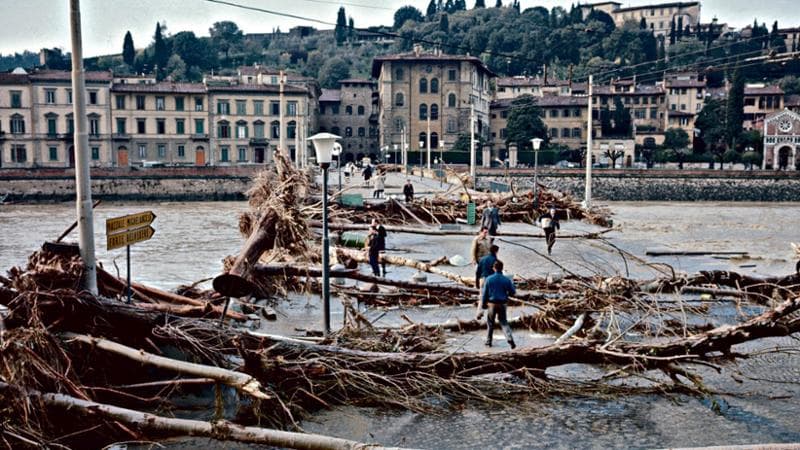
The Arno rises between Romagna and Tuscany, flows down toward the Casentino valley, points toward Arezzo, but then suddenly veers north. It slips between Terranuova and Montevarchi, crosses San Giovanni, Figline, Incisa, and then pushes upward to Pontassieve. There, its waters merge with those of the Sieve, which in turn collects every stream in the Mugello region.
The flooding
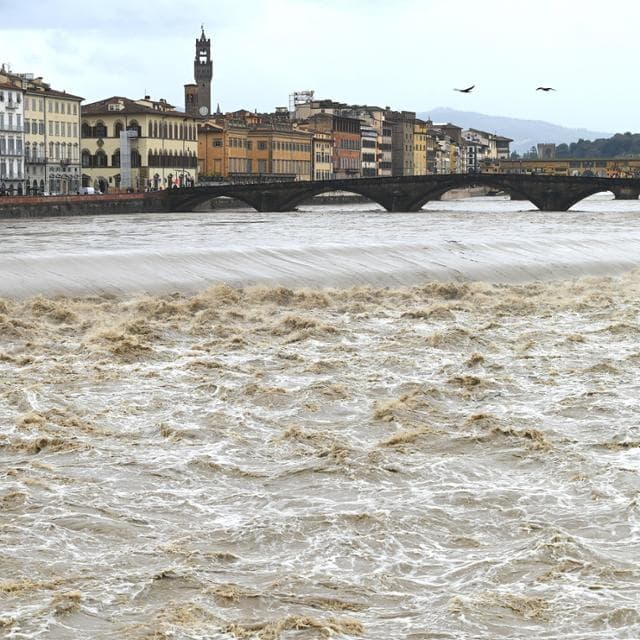
On the night between 3 and 4 November 1966, those waters grew vast beyond measure: three months of rain fell in a single day. The swollen Arno could no longer be contained within its battered riverbed and burst its banks.
At 11:00 a.m., water invaded streets and homes in Ponte a Poppi, flooding the Casentino valley and pressing relentlessly onward. It encountered two dams: La Penna and Levane. Nobody knew whether to open the sluice gates or hold out.
By evening, the situation became unsustainable; the floodgates at La Penna were opened, followed by those at the Levane dam. The deluge crashed down upon the Valdarno valley. It was a monstrous sight: families stranded on farm rooftops, animal carcasses drifting past, water and mud everywhere.
Florence is sleeping
The rain kept falling. The Arno destroyed everything in its path, gathering new force when it met the Sieve: the waters of the Mugello, Casentino, and upper Arno valleys poured into the river's battered bed, sweeping everything toward Florence. Against Florence.
Meanwhile, the city was asleep. It was resting ahead of 4 November, the holiday celebrating the Armed Forces. Nobody was at work, nor even at Mass: a public holiday, everyone stayed home. The water rose, and nobody knew whether to sound the alarm as the torrent reached one meter below the arches of Ponte Vecchio.
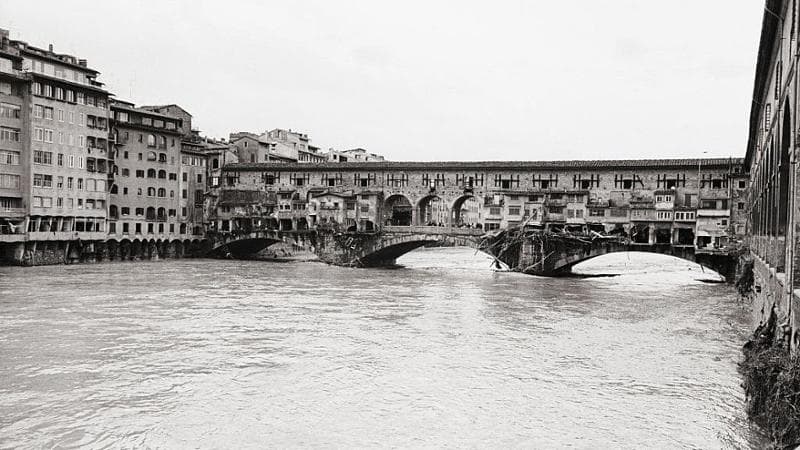
What might happen if an alarm were raised in a city of 400,000 residents in the dead of night? And besides: could the situation truly get any worse?
At 3:00 a.m., the Mugnone overflowed, submerging the Cascine park. Half an hour later, the Arno broke its banks at Rovezzano, San Salvi, and Varlungo. The sewers exploded, spurting water from manholes. Electrical substations blew out: power went down, taking phones, running water, and gas with it. The Arno invaded the National Central Library and Santa Croce.
At 7:26 a.m., every electric clock stopped dead.
Destruction without distinction
Torrents of water poured into Piazza del Duomo, flung open the doors of the Baptistery, and swept away panels from the Gates of Paradise. It was an ocean of foul colour, composed of water, sludge, and heating oil: every home had filled its tanks with fuel oil, and the Arno dragged it away alongside trees, cars, scooters, doors, furniture, road signs, works of art, garbage, and carcasses. Everything mixed together according to the most democratic of criteria: the indiscriminate destruction of everything.
By 10:00 a.m., the water had reached the first floors of buildings. On Via Scipione Ammirato, a loud explosion rang out: a storage site for carbide drums had blown up. Panic ensued.
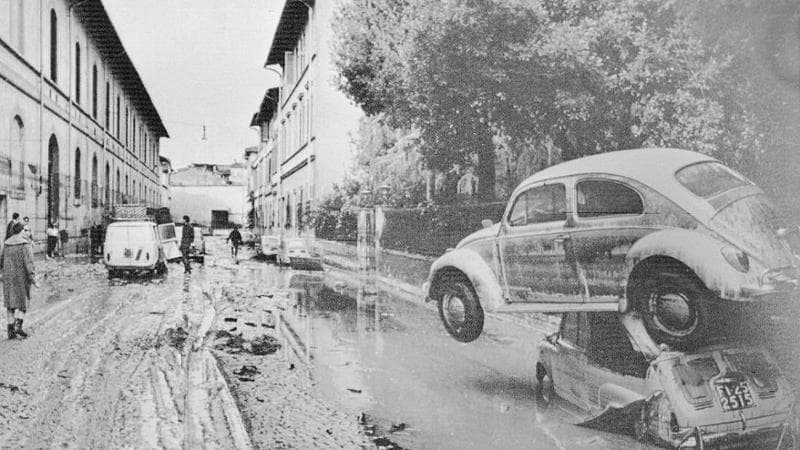
Roads, highways, and rail lines were severed. Thirty thousand cars were slammed against one another, transformed into barricades that defended against no enemy. The water shorted the electrical wiring in many vehicles, setting off a chilling, relentless chorus of car horns across the submerged city.
The bell of the Bargello tolled: it was the city's surrender.
A single yellow and black lake had swallowed Florence, which endured its tragedy split in two, with no bridge navigable. Reaching the outside world was impossible. And the world outside remained entirely oblivious, while the rain kept falling, refusing to stop—until 6:00 p.m. Then, silence. The water began to recede.
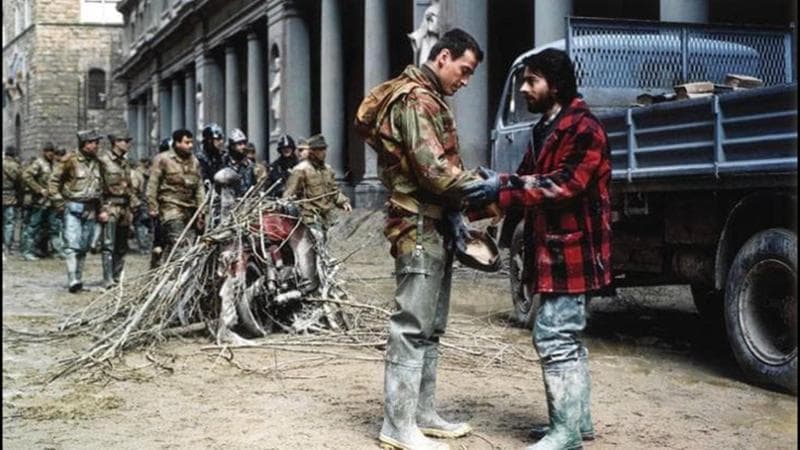
Impenetrable streets, rubble everywhere
What greeted Florentines on the morning of 5 November was a grotesque scene of postwar devastation. In place of the water lay a sea of mud. Impenetrable streets, sidewalks reduced to mounds of rubble. Ten feet up every wall, church, statue, home, and cinema ran a sickening black line, certifying: up to here came the Arno, 4 November 1966.
In Santa Croce, the river tore through and devastated Cimabue's Crucifix. At the National Central Library, 1.3 million volumes ended up underwater. At the Vieusseux Cabinet, 250,000. At the Georgofili Academy, 35,000. At the Great Synagogue, 14,000.
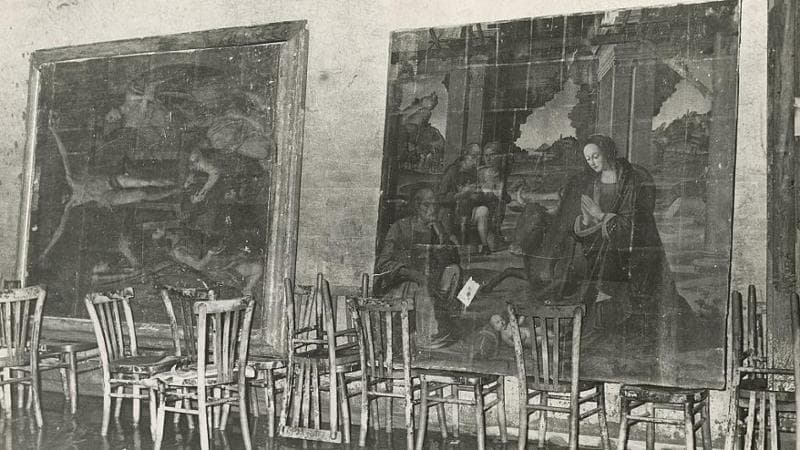
Inside the church of Santa Maria Novella, frescoes by Paolo Uccello were damaged. At Ognissanti, works by Botticelli, Ghirlandaio, and Vasari took the hit. Elsewhere, paintings by Lorenzetti, Simone Martini, and Neri di Bicci suffered the same fate.
Not even the Germans had dared go so far. It was a Nazi consul—civilized despite his affiliation, and deeply in love with Florence—who showed mercy at least to the Ponte Vecchio. On 4 November 1966, mercy was shown by no one.
Here ends the chronicle of the flood.
The rest of Tuscany still needs saving
Here should begin the second and third chapters: the abandonment by the state, followed by the resurrection, as former Florentine mayor Giorgio La Pira called it. But people always talk far too much about the "mud angels"—hand on heart, as if volunteers were the answer to every problem.
What Italy and Tuscany need is not repeated intervention by volunteers, but structural measures. Precise rules that are respected, alongside a fundamental shift in how we view the land and its fragile beauty. Instead, nothing: once Florence was more or less secured, the rest of Tuscany was left to be saved from the blindness of those who build and those who govern.
Without needing to dig through historical archives, painful floods emerge from recent memory: Lunigiana, Mugello, the island of Elba, Empoli, Sesto Fiorentino, the utter devastation of Campi Bisenzio, and the lives lost in Livorno.
The author is a writer and playwright.
This article was reviewed by an external translation partner