
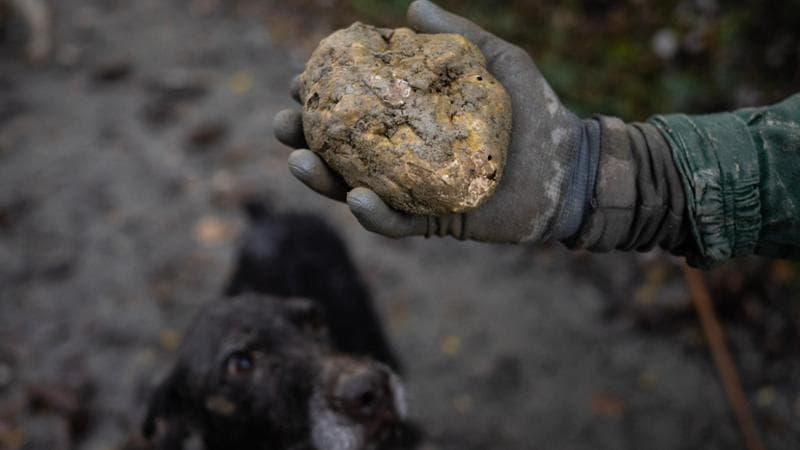
There was a time in Italy when people believed that a truffle would grow among the roots of any tree struck by lightning. This was the land of the Alba white truffle, the most prized of them all, fetching thousands of euros per kilogram.
Today, with summer thunderstorms becoming increasingly rare, this white gold is growing scarcer too. A summer of drought has weakened the mycelia, the networks of fungal filaments from which the precious nuggets that end up on our plates develop.
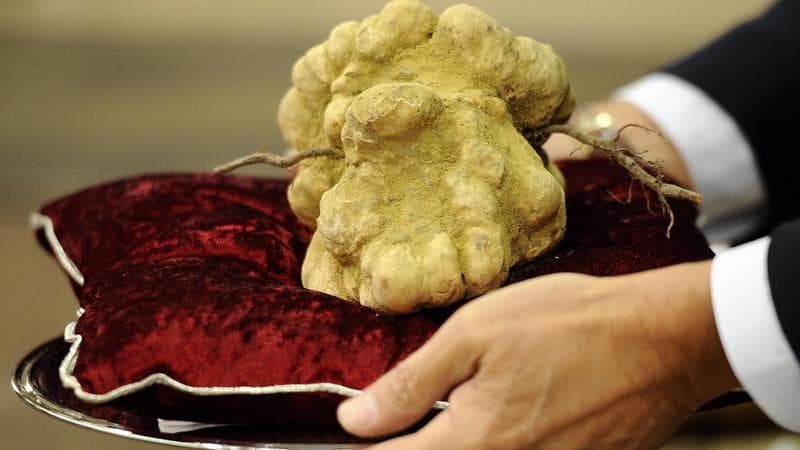
Running out of water
With the truffle-hunting season just under way, optimism among the trifolau, as truffle hunters are known locally, is proving even harder to find than the truffles themselves.
"If it doesn't rain before All Saints' Day, November 1, which marks the turning point of the season for us truffle hunters, we risk seeing the harvest fall by 50%," warns Giuseppe Marengo, a truffle hunter from Bene Vagienna, in the province of Cuneo.
"Truffles don't just need water to grow. Rain also brings out the scents of the forest that help our dogs find their way."
And weather forecasts suggest that autumn, too, will bring little rain.
"We've finished harvesting summer black truffles, which benefit from the spring rains. But we don't have high hopes for the more valuable varieties whose season is just beginning," confirms Giuseppe Cristini, director of the specialist website Accademia del Tartufo.
"We're unlikely to find specimens weighing 700 or 800 grams, although even a 100-gram truffle is excellent. Ideally, we'd have those cold nights when the ground freezes, followed by mild mornings when the moisture from the dew fills the forest with aromas."
Forests are becoming harder to access
Dry soil is not the only problem. "In the past, grazing animals kept the land clear. Now the forests are harder to access. Wild boar and porcupines get to the truffles before we do," explains Antonio Guerrini, a truffle hunter and dog breeder who heads the Club del Grifo Nero Valnerino, dedicated to a breed of dog specialising in truffle hunting, in Sellano, near Perugia.
Rain could still revive the harvest from November onwards. "That will be the decisive month. The season keeps shifting later and later," says Letizia Guerri, councillor for tourism in Città di Castello, a town with 1,500 truffle hunters and 3,000 dogs.
The International Alba White Truffle Fair will therefore open to the public on October 10, when the season is still expected to be off to a slow start. "Last year ended with prices of €3,500 to €4,000 per kilogram for premium white truffles," explains the fair's director, Stefano Mosca. "The start of this season could be difficult. Climate change is there for everyone to see. The danger is that truffles will become a food people simply can't afford. Today, a plate of tajarin, traditional Piedmontese egg pasta, costs around €30. If that rises to €70 or €80, it will become a niche luxury."
Breaking the taboo of cultivation
To prevent that from happening, the truffle industry has begun to overcome one of its longstanding taboos: cultivation.
While growing prized black truffles is already producing reasonably good results, efforts are now under way to cultivate the prized white variety, which has proved far more resistant to domestication. "We're starting to plant trees inoculated with truffle fungi," explains Mosca. "The local authorities in Roero already have one hectare ready, with another four to follow. It's not easy, and yields aren't high, but it's the only option we have."
Cultivating truffles is particularly challenging because the soil is an extraordinarily complex environment. Recreating the delicate balance of natural conditions remains difficult.
"Truffles absorb elements from their surroundings. Their aroma can depend on the composition of the soil," explains Raffaella Maria Balestrini, director of the Institute of Biosciences and BioResources at Italy's National Research Council (CNR).
"Black truffle cultivation has taken hold in many countries and now accounts for 80% of global production. This has brought prices down and helped address the problem of overexploitation of natural truffle grounds," explains Domizia Donnini, a professor of agricultural sciences at the University of Perugia. "With white truffles, the aim is to expand and improve the areas where they grow naturally, but there isn't much published data yet."
The spread of cultivated truffles has driven an increase in international trade in recent years. Spain is a major producer, alongside countries in South America, South Africa and Australia.
But this growing international market has made it increasingly difficult to establish where a truffle actually comes from, creating a complex scientific challenge involving traceability.
"Genome sequencing and chemical analysis can identify a truffle's geographical origin, but these are complicated procedures, used mainly in cases of suspected fraud," explains Balestrini.
This is why truffles do not carry Italy's DOC or DOP origin certification labels.
How science is helping
Science has also come to the aid of those pioneering truffle cultivation. Beyond DNA sequencing, which has identified the genes responsible for flavour, researchers have made another important discovery. "We've discovered that even mycelia have something resembling biological sexes," says Balestrini. "Some carry a positive mating-type gene, others a negative one. When establishing a truffle plantation, one of the things you have to do is make sure you recreate the right balance between the two."
The translation of this article was reviewed by a Language Service Provider