
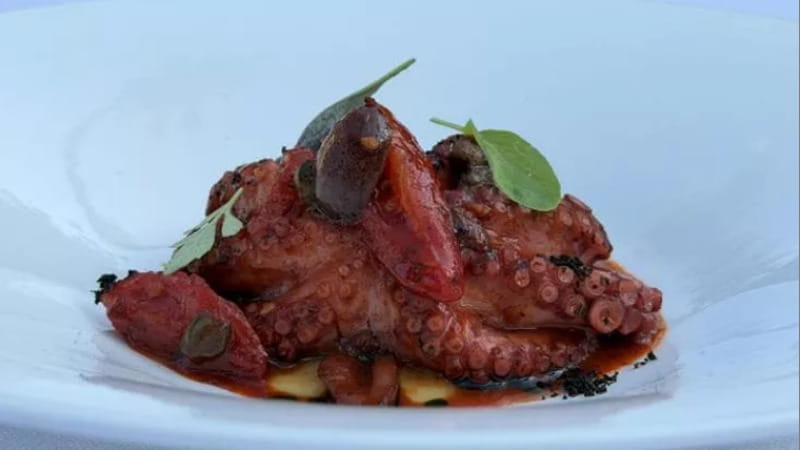
It is called alla Luciana because it originated in the seaside neighbourhood of Santa Lucia in Naples. Local fishermen, known as Luciani, would cook their freshly caught octopus according to one simple rule: the octopus should cook in its own liquid.
Luciana-style octopus is therefore one of those dishes where experience matters more than technique. The most important part is cooking the octopus properly, something you learn by doing. Cherry tomatoes, olives, capers, garlic and parsley create the flavourful base in which the octopus slowly cooks in its own liquid.
In the version created by Luigi Lionetti, executive chef of Cora, the restaurant at the Ara Maris hotel in Sorrento, baby octopus takes centre stage, served on a cream made with chickpeas from Controne. The dish also features on the restaurant’s tasting menu, where it is served as the second appetiser. “It’s proving extremely popular, and sometimes customers even ask for a second helping. Octopus, after all, is a real crowd-pleaser: almost everyone loves it.”
Ingredients for 2–3 people
For the baby octopus or octopus
500g baby octopus or octopus
2 garlic cloves
1 fresh chilli
50g black olives
20 salt-cured capers
250g datterini tomatoes
50g extra-virgin olive oil
Parsley
Anchovy colatura, as needed
For the chickpea cream
200g cooked chickpeas
10g celery
10g carrot
10g Nocerino spring onion
A few parsley stalks
1 bay leaf
Extra-virgin olive oil, as needed
“The first thing,” the chef explains, “is to decide whether you’re using a larger octopus or baby octopus, because they need to be treated differently. A larger octopus can be cut into pieces, but it needs longer cooking. Baby octopus requires an even more delicate touch: it needs to curl up properly and tenderise slowly, without being exposed to too much heat. If the temperature is too high, it can become tough.”
Cooking: temperature is the secret
Rinse the capers thoroughly to remove any excess salt. Wash the tomatoes and cut them in half. Clean the baby octopus, rinse it under running water and dry it thoroughly. Pour the oil into a saucepan and add the garlic cloves, capers, chilli and a few parsley stalks. Let them sizzle gently, then add the tomatoes and turn up the heat for a few minutes, until they begin to brown and soften slightly.
Lionetti starts with a base of garlic, capers and extra-virgin olive oil, but he does not add the baby octopus straight away. “I let the garlic sizzle, then turn off the heat and wait a couple of minutes for the oil to cool to around 60–70°C. Only then do I add the baby octopus and return the pan to a very low heat. If you want tender octopus, you have to treat it gently.”
Be gentle with the octopus
Turn off the heat and wait a couple of minutes for the oil temperature to fall. Add the baby octopus while the pan is off the heat, stir it into the other ingredients, then return the saucepan to the hob. Cover and cook over a very low heat for around 35–40 minutes. The baby octopus should simmer gently in the liquid it releases as it cooks. If the pan becomes too dry, add just a small amount of hot water.
There is no single cooking time that works in every case. An octopus weighing around 500g may take 40–45 minutes, but its size, texture and moisture content can all affect the result. “You need to feel it with your fingers or try piercing it with a fork. And above all, taste it.” In the kitchen, you cannot rely on the clock alone.
Add the olives at the end
Add the olives only during the final few minutes so that they retain their texture and do not impart too much bitterness to the sauce. Remove the garlic and parsley stalks. Finish with freshly chopped parsley and a few drops of anchovy colatura. Do not add salt until you have tasted the dish, as the octopus, capers, olives and colatura already provide plenty of savouriness.
“There’s no need for salt. Octopus already has a natural saltiness, and I prefer to enhance it with a little anchovy colatura, which adds depth without overpowering the other ingredients.”
The chickpea cream
At Cora, the baby octopus is served on a cream made with Controne chickpeas from Cilento, prepared with a vegetable base scented with bay leaf and parsley stalks. Once cooked, they are finished with black olives, capers and datterini tomatoes.
To make the cream, trim the celery, carrot and spring onion and finely chop them. Sweat them gently in a saucepan with a little extra-virgin olive oil, the parsley stalks and bay leaf. Add the cooked chickpeas and let them absorb the flavours for a few minutes.
Remove the bay leaf and parsley stalks, then blend, gradually adding enough chickpea cooking water or vegetable stock to produce a smooth, velvety cream. Keep warm.
Spoon the chickpea cream onto the plates, arrange the baby octopus on top and finish with the cooking juices.
The translation of this article was reviewed by a Language Service Provider