
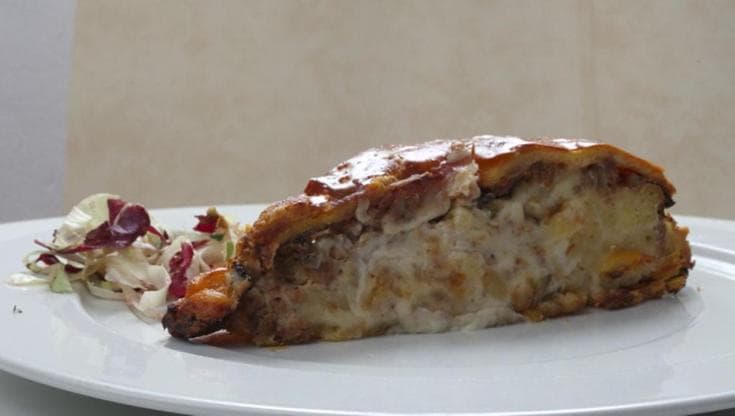
From the outside, it looks like a cake, but inside it conceals maccheroncini, béchamel sauce, white ragù, Parmesan and truffle.
The Ferrara-style macaroni pie is one of those dishes that seem to come straight from another era- in this case, the Renaissance.
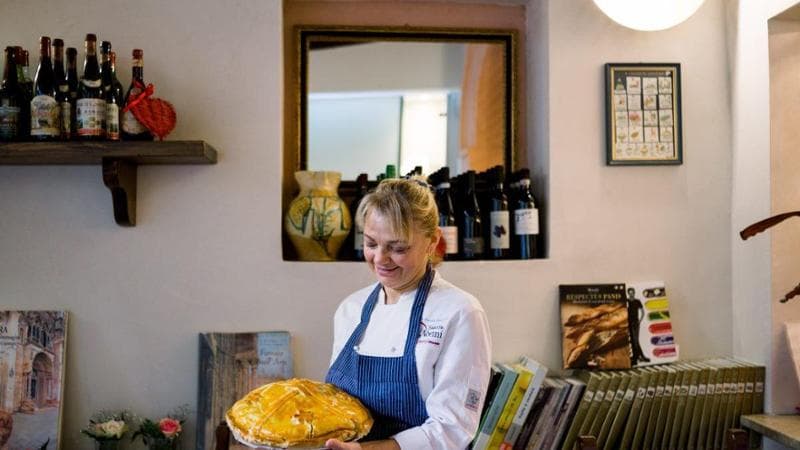
It is a sumptuous dish that takes a long time to prepare, in which sweetness of the shortcrust pastry is perfectly balanced by the savoury flavour of the filling. The recipe comes from Maria Cristina Borgazzi of the Da Noemi restaurant in Ferrara, where the Ferrara-style macaroni pie is always on the menu.
To make it, she explains, organization is key: the preparations are done a day in advance and, when it comes to assembling the dish (which is the essential, visually striking part of the recipe), everything must be cold.
“It is a ‘slow food’ dish. Talking about slow food today is quite a challenge, because everyone is in such a hurry to cross the finish line. But this is definitely a recipe you need to devote yourself to, whilst having fun at the same time. In the end, the sense of accomplishment is magnificent.”
Ingredients for 6–8 people
For the shortcrust pastry
500 g plain flour
200 g cold butter
150 g sugar
120 ml cold water
2 egg yolks
For the ragù
200 g minced pork
200 g minced veal
100 g sausage
300 g chicken livers
700 ml whole milk
1 glass white wine
1 glass dry Marsala
1 onion, 1 clove of garlic
Rosemary,
Bay leaf
Salt and pepper
For the béchamel sauce and the maccheroncini
1 l whole milk
70 g butter
42 g flour
50 g truffle butter
300 g maccheroncini (such as sedanini)
Parmigiano Reggiano (to taste)
Nutmeg
Salt and pepper
To finish
Fresh truffle
Parmigiano Reggiano
1 egg yolk (for brushing)
Step 1: The Shortcrust Pastry
Mix the flour, cold butter, sugar, cold water, and egg yolks until you have a smoothdough. Wrap it up and keep it in the refrigerator overnight.
Step 2: The Ragù
In a non-stick frying pan, brown the sausage over medium-high heat, stirring until nicely browned. Add the pork first, followed by the veal, continuing to brown. When the meat is well browned, deglaze with white wine, allowing it to evaporate completely. Reduce the heat, add the milk and onion, and continue cooking until the milk has been completely absorbed. Season with salt and pepper. In a separate pan, brown the chicken livers with garlic, rosemary, and bay leaf. Deglaze with the dry Marsala, season with salt and pepper, chop them finely with a knife and add them to the ragù. Leave to cool completely and refrigerate overnight.
Step 3: The Béchamel Sauce and the Maccheroncini
Bring the milk to the boil. Meanwhile, melt the butter over low heat, add the flour, and make a roux. As soon as the milk boils, remove from the heat, add the roux, and stir with a whisk. Season with salt and pepper and stir in the Parmigiano Reggiano, and nutmeg. Cook the maccheroncini until al dente, drain them and mix them into the béchamel sauce. Add the truffle butter and set aside to cool completely overnight.
A Golden Rule: Everything Must Be Cold
According to Borgazzi, temperature is the key secret to success here: “Every single element must be very cold—the pastry, the béchamel sauce, the maccheroncini, and the ragù. If everything is cold, you can manage the preparation well. If, on the other hand, the ingredients are hot, they’ll spill out everywhere….”
The Next Day: Assembly
Take a portion of the shortcrust pastry for the base of the pie and roll it out with a rolling pin until you have a disc about 3–4 millimetres thick. Place it in a shallow, round 22–24 cm baking tin. Prick the base with a fork and pre-bake in a conventional oven at 160°C (320°F) for 6 to 7 minutes. Remove it from the oven and leave it to cool completely.
Next, start preparing the filling. Arrange a layer of the béchamel-coated maccheroncini onto the base, followed by a layer of the white ragù, a sprinkling of Parmigiano Reggiano, and the fresh truffle—either finely shaved or grated.
Building the Characteristic Dome Shape
Repeat the layering process in the same sequence, gradually making them narrower as you go upwards to achieve the characteristic domed shape. “You need to build up the layers, using your hands to shape it into a dome,” Maria Cristina explains.
Once the dome is complete, leave the pastry to rest in the refrigerator for about 20 minutes. Meanwhile, roll out the remaining shortcrust pastry into a second disc, slightly larger than the first and about 3 millimeters thick, setting aside a small amount of pastry for the decorative details.
Remove the pie from the fridge and carefully place the disc over the dome, gently guiding it into place with your hands to maintain the shape. Pinch the edges firmly together and seal them with your fingers. Using some of the leftover pastry, you can form a strip to place around the circumference, pressing it down firmly to seal the pie.
Lightly prick the surface with a fork. Maria Cristina explains that this is to “let the air that builds up inside during cooking escape”.. Brush the entitre surface with egg yolk and return the pie to the fridge for a few minutes. Use the leftover pastry to make decorations in your favourite shapes, place them on the surface and brush them with egg yolk as well.
Patience Before Baking
Maria Cristina recommends letting the pie rest for a longer period before baking: “Once it’s ready, I’d leave it it in the fridge for a couple of hours. In fact, you can prepare it the day before and bake it the next day.”Bake in a conventional oven at 140°C (285°F) for approximately one hour. If the surface starts to brown too much during baking, cover it with a sheet of aluminum foil and continue baking.
How to Serve
Once it’s out of the oven, don’t cut it straight away. The pie should be served lukewarm, after resting for about twenty minutes. Then cut it into wedges, just like a cake. Size matters too. The pie must be large enough to ensure the right balance between the pastry and the filling.
And should you have any left over, it tastes even better the next day.
This article was reviewed by an external translation partner